
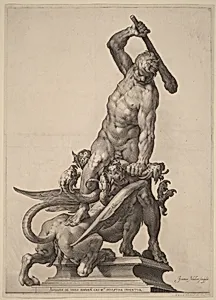
Hercules Killing the Hydra
Medium
engraving
Dimensions
plate: 51.1 x 36.5 cm (20 1/8 x 14 3/8 in.) sheet: 52.2 x 37.8 cm (20 9/16 x 14 7/8 in.)
Classification
Department
CG-E
Museum
National Gallery of Art, Washington, D.C.
Credit
Ailsa Mellon Bruce Fund
Accession Number
1971.36.3
Rights
Public Domain
Art Historical Context
Behold *Hercules Killing the Hydra*, a dynamic engraving by Jan Muller, created around 1602 after a bronze sculpture by the renowned Mannerist artist Adriaen de Vries. This print (plate size: 51.1 x 36.5 cm) captures mythic hero Hercules in the midst of his second labor from Greek mythology, battling the multi-headed serpent Hydra in a whirlwind of twisting forms and straining muscles. Muller's precise engraving translates de Vries' sculptural drama into two dimensions, showcasing the sculptor's signature elongated figures and exuberant movement typical of Northern Mannerism. Engravings like this were revolutionary in the early 17th century, serving as affordable reproductions that brought elite sculptures to collectors, scholars, and enthusiasts across Europe. Muller's technique—incising fine lines into a copper plate with a burin—allows for intricate details, from the Hydra's writhing necks to Hercules' Herculean physique, evoking the tension and heroism of the classical tale. Acquired through the Ailsa Mellon Bruce Fund and housed in the National Gallery of Art's Prints department, it exemplifies how printmaking democratized art during the Renaissance. This work not only celebrates human triumph over chaos but also bridges sculpture and print cultures, inviting us to marvel at the enduring power of ancient myths reimagined in early modern mastery.