
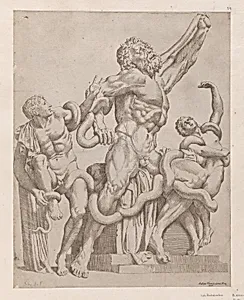
Speculum Romanae Magnificentiae: Laocoon
Medium
Etching
Dimensions
sheet: 14 15/16 x 11 5/8 in. (38 x 29.6 cm) mount: 18 7/8 x 14 3/4 in. (48 x 37.4 cm)
Classification
Prints
Department
Drawings and Prints
Museum
Metropolitan Museum of Art, New York, NY
Credit
Harris Brisbane Dick Fund, 1941
Accession Number
41.72(2.79)
Rights
Public Domain
Tags
Art Historical Context
Step into the Renaissance fascination with ancient Rome through *Speculum Romanae Magnificentiae: Laocoon*, an exquisite etching from 1561 by Sisto Badalocchio and Agostino Veneziano (Agostino dei Musi). This print captures the dramatic Hellenistic sculpture of Laocoon, the Trojan priest and his sons entwined by sea serpents—a masterpiece rediscovered in 1506 that captivated artists like Michelangelo. Measuring nearly 15 by 11.5 inches on the sheet, it's a precise reproduction that highlights the male nude's muscular torment, tagged aptly for its raw anatomical power. Part of the renowned *Speculum Romanae Magnificentiae* ("Mirror of Roman Magnificence") series, compiled by publisher Antonio Lafreri, this work exemplifies 16th-century etching techniques. Veneziano, a master engraver, likely translated Badalocchio's design into intricate lines that convey texture, shadow, and motion, making classical antiquity accessible to scholars and collectors across Europe. Housed in the Metropolitan Museum of Art's Drawings and Prints department (Harris Brisbane Dick Fund, 1941), it reflects the era's humanist revival, fueling the study of Greco-Roman art amid Rome's rediscovery. This piece isn't just a copy—it's a cultural bridge, inviting us to marvel at how Renaissance printmakers democratized the grandeur of ancient sculptures, inspiring generations to explore humanity's dramatic myths.
About the Artist
Sisto Badalocchio|Agostino Veneziano (Agostino dei Musi) · 1585–1647
Comment on works: Religious