
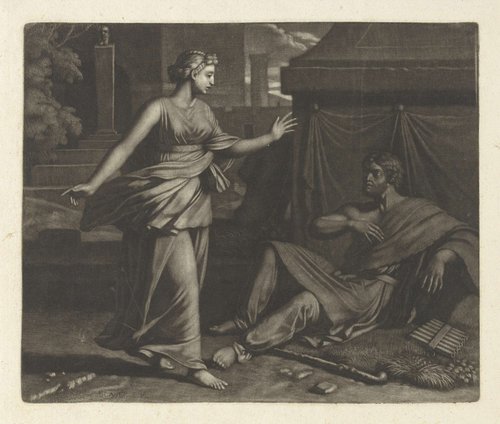
Herder en een vrouw
1656 - 1726
Medium
paper
Dimensions
265; 220
Rights
Public Domain
About this artwork
collector's mark: Lugt 2228
Art Historical Context
Johannes Glauber's "Herder en een vrouw" captures a quiet pastoral encounter between a shepherd and a woman, rendered as a delicate drawing on paper. Measuring just 220 by265 millimeters, the intimate invites close viewing and suggests the work may have been created as a preparatory study or a collectible sheet rather than a large finished painting. The title hints at the timeless Arcadian themes popular among Dutch artists of the late seventeenth and early eighteenth centuries, when idealized rural scenes offered viewers an escape into harmonious nature. Active between 1656 and 1726, Glauber worked during the final flowering of the Dutch Golden Age. His drawings often combined landscape and figure elements, reflecting the period's fascination with classical simplicity and the beauty of everyday rural life. The presence of the collector's mark Lugt 2228 further enriches the sheet's story, testifying to its journey through distinguished private collections and its enduring appeal to connoisseurs. Such works on paper remind us of drawing's central role in artistic practice of the time, allowing artists to explore composition and light with spontaneity before committing ideas to canvas.
About the Artist
Johannes Glauber · 1646–1726
**Johannes Glauber (1646–c. 1726)** was a Dutch Golden Age painter renowned for his Italianate landscapes and decorative wall paintings. Born in Utrecht, he pursued art against the wishes of his father, the prominent chemist Johann Rudolph Glauber. He became a pupil of Nicolaes Berchem and lived for a time with Gerrit van Uylenburgh in Amsterdam, where he produced copies of Italianate landscapes f...