
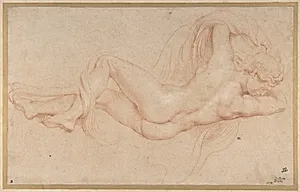
Hermaphrodite
17th century
Medium
Red chalk heightened with white
Dimensions
9 1/16 x 14 1/2 in. (23 x 36.8 cm)
Classification
Drawings
Department
Drawings and Prints
Museum
Metropolitan Museum of Art, New York, NY
Credit
Bequest of Walter C. Baker, 1971
Accession Number
1972.118.286
Rights
Public Domain
Tags
Art Historical Context
Peter Paul Rubens, the preeminent Flemish Baroque artist of the 17th century, masterfully captured the human form in this exquisite drawing titled *Hermaphrodite*. Created as a preparatory study, it exemplifies Rubens' renowned draftsmanship, where he explored dynamic poses and sensual anatomy to inform his grand paintings and frescoes. The subject draws from classical mythology—Hermaphroditus, son of Hermes and Aphrodite, who merged with the nymph Salmacis—reflecting the era's fascination with antique sources and the fluid boundaries of gender and beauty during the Baroque period. Executed in red chalk heightened with white on paper, the medium lends a warm, lifelike glow to the figure's voluptuous contours. Red chalk, or sanguine, allowed Rubens to achieve rich tonal modeling, while the white heightening creates dramatic highlights, mimicking the luminosity of his oil paintings. Measuring just 9 1/16 x 14 1/2 inches, this intimate sheet reveals the artist's meticulous process: fluid lines build volume and movement, showcasing his innovative blend of Italian Renaissance influences like Michelangelo with Northern vigor. Now in the Metropolitan Museum of Art's Drawings and Prints department, thanks to the 1971 bequest of Walter C. Baker, this work highlights Rubens' enduring legacy in figure studies. It invites visitors to appreciate how such sketches bridged the gap between idea and masterpiece, embodying the Baroque celebration of the body's vitality and complexity.
About the Artist
Peter Paul Rubens · 1577–1640
Peter Paul Rubens (1577-1640) stands as the most influential artist of the Flemish Baroque tradition and the greatest exponent of Baroque painting's dynamism, vitality, and sensuous exuberance. Born in Siegen, Westphalia, and raised in Antwerp, Rubens received a humanist education studying Latin and classical literature before pursuing artistic training under three masters: Tobias Verhaecht, Adam ...