
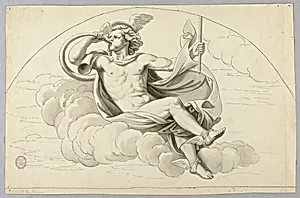
Hermes
Medium
Drawing
Classification
Drawing
Department
Smithsonian Collection
Museum
Smithsonian American Art Museum
Credit
Smithsonian American Art Museum
Accession Number
1897-9-10
Rights
Public Domain
About this artwork
Research in Progress
Art Historical Context
**Hermes** *Johann August Nahl the (German, 1752–1825), ca. 1781* *Drawing; Smithsonian American Art Museum* into the graceful world of late 18th-century German draftsmanship with *Hermes* by Johann August Nahl the. Created around 1781, this drawing captures the swift-footed messenger god of Greek mythology, a figure synonymous with commerce, travel, and divine eloquence. Nahl, a sculptor and illustrator active at courts in Mannheim and Kassel, bridged Rococo elegance and emerging Neoclassicism, channeling classical antiquity during the Enlightenment era when artists revived ancient myths to inspire modern sensibilities. As a preparatory drawing—likely in ink or chalk on paper—this work highlights Nahl's mastery of line and form, essential for translating fluid motion into sculpture. Hermes, often depicted with winged sandals and caduceus staff, embodies the era's fascination with idealized beauty and heroic narratives. Though research on this piece is ongoing, it reflects Nahl's versatile practice, blending technical precision with mythological allure. Housed in the Smithsonian American Art Museum, *Hermes* invites us to ponder how European neoclassical traditions influenced global collections, offering a window into an artist's creative process amid revolutionary times. A testament to enduring classical reverence! (178 words)