
Herrenhut in Saxony
1754/1816
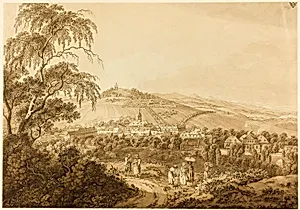
Medium
Etching in dark brown with handcoloring in brown washes on cream wove paper
Dimensions
Sheet, trimmed within platemark and image: 30.3 × 43.2 cm (11 15/16 × 17 1/16 in.)
Classification
etching
Department
Prints and Drawings
Museum
Art Institute of Chicago
Accession Number
152325
Rights
Public Domain
Art Historical Context
Adrian Zingg's *Herrenhut in Saxony* (1754/1816) captures the serene Moravian settlement of Herrenhut, a Protestant community founded in 172 in eastern Germany. This etching offers a detailed topographical view of the village nestled in the Saxon countryside, reflecting Zingg's expertise as a Swiss-born engraver and landscape specialist who worked extensively in Leipzig. Trained in the tradition of precise 18th-century printmaking, Zingg contributed to the era's growing fascination with accurate depictions of European locales, blending artistic finesse with documentary intent. Rendered as an etching in dark brown ink with subtle handcoloring in brown washes on cream wove paper, the work exemplifies the technical virtuosity of etching—a process where acid bites into a metal plate to create intricate lines ideal for capturing textures like rolling hills and clustered buildings. The handcoloring adds warmth and depth, enhancing the print's appeal as a collectible view, trimmed to 30.3 × 43.2 cm for intimate display. Such colored etchings were prized in the Enlightenment period for their blend of artistry and information. Housed in the Art Institute of Chicago's Prints and Drawings Department, this piece highlights Herrenhut's cultural significance as a hub of religious renewal, inviting visitors to appreciate how Zingg's veduta-style print bridges topography and history, evoking the spiritual landscape of 18th-century Saxony.
About the Artist
Adrian Zingg · 1734–1816
Comment on works: Landscape draughtsman; engraver; etcher