
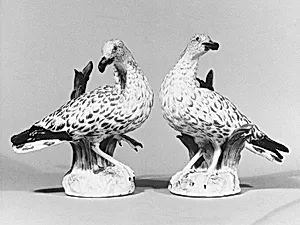
Herring gull (one of a pair)
Medium
Hard-paste porcelain
Dimensions
Height: 11 in. (27.9 cm)
Classification
Ceramics-Porcelain
Culture
German, Meissen
Department
European Sculpture and Decorative Arts
Museum
Metropolitan Museum of Art, New York, NY
Credit
The Lesley and Emma Sheafer Collection, Bequest of Emma A. Sheafer, 1973
Accession Number
1974.356.399
Rights
Public Domain
Tags
Art Historical Context
This exquisite porcelain figure of a herring gull, around 1750 by the renowned Meissen Manufactory modeled by Johann Joachim Känd, captures the bird's poised elegance in mid-stride. Standing 11 inches tall, it forms one of a pair, showcasing the rococo flair for naturalistic yet whimsical animal sculptures that adorned 18th-century European aristocratic tables and cabinets. Meissen, founded in 1710 near Dresden, Germany, revolutionized ceramics as Europe's first producer of hard-paste porcelain—a durable, translucent material fired at high temperatures, rivaling prized Chinese imports. Kändler, Meissen's star sculptor from the 1730s onward, mastered intricate modeling techniques, hand-forming details like the gull's feathers, beak, and alert eyes before polychrome glazing and firing brought vibrant life to the surface. These figures exemplified the manufactory's technical prowess and secrecy-guarded formulas. A highlight of the Metropolitan Museum of Art's European Sculpture and Decorative Arts collection, gifted through the Lesley and Emma Sheafer bequest, this gull reflects the cultural obsession with nature in rococo design—blending scientific observation with playful luxury for the elite. Imagine it perched among delicate porcelain swans or harlequin figures, a testament to Meissen's enduring legacy in decorative arts.
About the Artist
Meissen Manufactory|Johann Joachim Kändler · 1710–present
The Meissen Manufactory, established on June 6, 1710, by Augustus the Strong, Elector of Saxony and King of Poland, marked the dawn of true hard-paste porcelain production in Europe. Nestled at Albrechtsburg Castle in Meissen near Dresden, the Royal Polish and Electoral Saxon Porcelain Manufactory arose from alchemical experiments begun in 1708 by physicist Ehrenfried Walther von Tschirnhaus and p...