
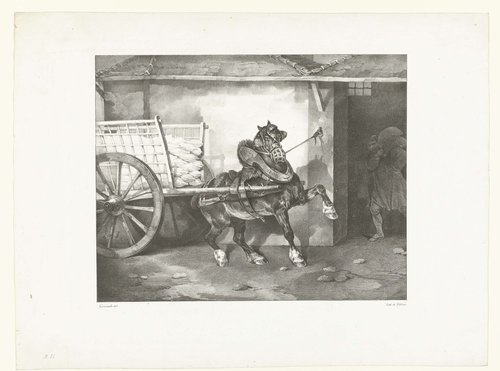
Het paard van de stukadoor
Medium
lithography
Dimensions
321; 489; 256; 376
Rights
Public Domain
About this artwork
collector's mark: Lugt 2228
Art Historical Context
### Théodore Géricault's *Het Paard van de Stukadoor* Step into the dynamic world of Théodore Géricault with this striking 1822 lithography, titled *Het Paard van de Stukadoor*—Dutch for "The Plasterer's Horse." Measuring 256 mm high by 321 mm wide, this print captures Géricault's masterful observation of equine form during his final creative years. Bearing the collector's mark Lugt 2228, it hints at its prized status among connoisseurs, linking it to esteemed provenance. As a leading figure of French Romanticism, Géricault (1791–1824) was obsessed with horses, portraying them with raw energy and anatomical precision in works like *The Raft of the Medusa*. This piece reflects his time in England (1820–1822), where he produced innovative horse studies. Lithography, a revolutionary medium invented just two decades earlier, allowed Géricault to blend drawing's spontaneity with printmaking's reach, making art accessible beyond elite circles. *The Plasterer's Horse* showcases his technique: bold lines and textured shading evoke the horse's muscular vitality, likely a humble working animal. Created just before his untimely death at 32, it exemplifies Romanticism's celebration of nature's power and everyday life, bridging fine art with the grit of labor. A gem for any visitor exploring 19th-century innovation! (198 words)
About the Artist
Théodore Géricault · 1791–1824
Théodore Géricault (1791-1824) stands as one of the most influential pioneers of French Romanticism, despite a career tragically cut short at age thirty-two. Born in Rouen on September 26, 1791, into a wealthy family, Géricault's brief but intense artistic life transformed the trajectory of nineteenth-century European painting. Géricault began his formal training in 1808 under Carle Vernet, maste...