
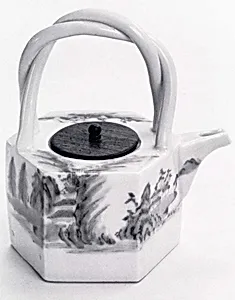
Hexagonal Sake Ewer with Landscape Design
Unknown Artist
early 19th century
Medium
Porcelain with underglaze blue decoration (Hirado ware)
Dimensions
H. (Handle to base) 6 3/4 in. (17.1 cm); W. (inc. end of spout) 6 1/8 in. (15.6 cm);
Classification
Ceramics
Culture & Period
Japan · Edo period (1615–1868)
Department
Asian Art
Museum
Metropolitan Museum of Art, New York, NY
Credit
Dr. and Mrs. Roger G. Gerry Collection, Bequest of Dr. and Mrs. Roger G. Gerry, 2000
Accession Number
2002.447.126a, b
Rights
Public Domain
Tags
Art Historical Context
This exquisite hexagonal sake ewer, crafted in early 19th-century during the Edo period (5–1868), the refined artistry of Hirado ware. Produced on the island of Hirado in Nagasaki Prefecture, this type of ceramic was renowned for its thin, translucent body and delicate underglaze blue decoration a technique where cobalt pigment is applied beneath the glaze before firing, yielding vibrant, enduring blues resistant to wear. The ewer's faceted hexagonal form—standing just 6¾ inches tall and 6⅛ inches wide—adds an elegant geometric flair, while the landscape design evokes Japan's deep reverence for nature, perhaps depicting misty mountains or serene vistas typical of the period's aesthetic. Sake ewers like this were essential in social rituals, pouring warmed rice wine during gatherings or tea ceremonies, reflecting Edo Japan's prosperous merchant culture and ukiyo-e-inspired appreciation for everyday beauty. Hirado kilns, influenced by imported Chinese porcelain but distinctly Japanese in subtlety, catered to elite tastes, blending functionality with artistry. Though the maker remains unknown, this piece from the Dr. and Mrs. Roger G. Gerry Collection at The Metropolitan Museum of Art highlights the era's technical mastery and cultural harmony. Visitors, imagine the soft clink as it dispenses sake under lantern light—a tangible link to Japan's vibrant past.