
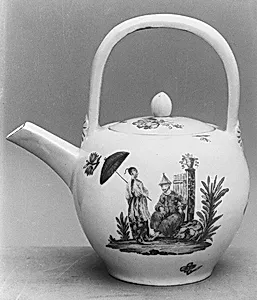
Teapot
Medium
Hard-paste porcelain
Dimensions
Height: 6 in. (15.2 cm)
Classification
Ceramics-Porcelain
Culture
Austrian, Vienna
Department
European Sculpture and Decorative Arts
Museum
Metropolitan Museum of Art, New York, NY
Credit
The George B. McClellan Collection, Gift of Mrs. George B. McClellan, 1941
Accession Number
42.205.14a, b
Rights
Public Domain
Tags
Art Historical Context
This elegant teapot, crafted around 1740 at the Vienna porcelain factory established by Claudius Innocentius Du Paquier, represents one of the earliest successes in European hard-paste porcelain production. Founded in 1718, the Du Paquier manufactory was only the second in Europe—after Meissen—to master the Chinese secret of true porcelain using kaolin and feldspathic rock. Standing just six inches tall, the vessel showcases the refined technical skill of Viennese artisans who transformed local materials into luminous, translucent forms suitable for aristocratic tea tables. The teapot’s decoration reflects the era’s fascination with Chinoiserie, featuring delicately painted human figures in imagined Eastern landscapes. Such motifs allowed European makers to evoke the exotic allure of imported Chinese wares while asserting their own inventive style. The combination of playful scenes with the material’s durability and beauty made these objects prized symbols of Enlightenment-era taste and global trade connections. Today, this piece from the Metropolitan Museum’s collection highlights Austria’s brief but influential role in the story of porcelain, bridging courtly luxury with the broader cultural exchange that shaped 18th-century decorative arts.