
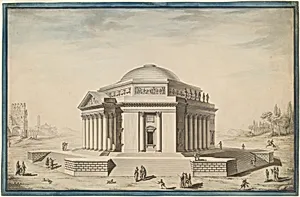
Hexagonal Temple in an Italianate Landscape
c. 1780
Medium
pen and black ink with watercolor and gray wash within a border drawn in blue watercolor and pen and black ink on laid paper extensively pricked for transfer
Dimensions
image: 34.8 x 55 cm (13 11/16 x 21 5/8 in.) sheet: 37.2 x 57 cm (14 5/8 x 22 7/16 in.)
Classification
Drawing
Department
CG-E
Museum
National Gallery of Art, Washington, D.C.
Credit
William B. O'Neal Fund
Accession Number
1998.28.3
Rights
Public Domain
Art Historical Context
Louis Gustave Taraval’s *Hexagonal Temple in an Italianate Landscape* captures the late-eighteenth-century fascination with classical antiquity and idyllic Italian scenery. Created around 1780, the drawing presents a graceful, six-sided temple set within a serene, imagined landscape, evoking the kind of picturesque ruins that captivated European artists and travelers during the Grand Tour era. The balanced composition and delicate architectural details reflect the period’s neoclassical taste for harmony, proportion, and references to ancient Rome. The work is executed in pen and black ink with watercolor and gray wash, all enclosed within a carefully ruled blue border. Its surface is extensively pricked for transfer, indicating that the design was likely intended to be reproduced—perhaps as a print, decorative panel, or architectural study. This meticulous technique underscores Taraval’s role as both draftsman and designer, bridging fine art and applied decoration in the refined visual culture of the late Enlightenment. Housed in the National Gallery of Art, this drawing offers visitors a glimpse into the preparatory processes behind eighteenth-century landscape and architectural imagery.
About the Artist
Louis Gustave Taraval · 1738–1794
Taraval served as inspector for the Bâtiments du Roi. According to Macmillan, he was influential in the publication of several important architects, including Pierre Contant D'Ivry and Jean François Chalgrin.