
Ôhi (Stole)
Meiji period (1868–1912), 1875/1900
Medium
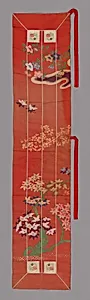
Silk and gold-leaf-over-lacquered-paper strips, warp-float faced 2:1 'Z' twill weave with supplementary brocading wefts bound in 1:2 and 5:1 'S' twill interlacings; patches: silk and gold-leaf-over-lacquered-paper strips, warp-float faced 2:1 'Z' twill weave with 1:2 'Z' twill interlacings of secondary binding warps and supplementary patterning wefts; cords: silk wrapped cotton; lined with silk, 5:1 twill damask weave
Dimensions
155.4 × 32.6 cm (61 1/8 × 12 7/8 in.)
Classification
textile
Department
Textiles
Museum
Art Institute of Chicago
Accession Number
150743
Rights
Public Domain
Art Historical Context
This exquisite ôhi, or stole, hails from Japan's Meiji period (186–1912), a transformative era when the nation blended ancient traditions with Western influences. Dated around 1875–1900, this ceremonial garment—likely worn by Buddhist or Shinto priests during rituals—exemplifies the enduring mastery of Japanese textile artisans amid rapid modernization. Measuring 1554 × 32.6 cm, its narrow, elongated form was designed to drape over robes, symbolizing spiritual authority and elegance. Crafted from silk and shimmering gold-leaf-over-lacquered-paper strips, the stole features a warp-float faced 2:1 'Z' twill weave with supplementary brocading wefts bound in intricate 1:2 and 5:1 'S' twill interlacings. Patches employ similar techniques with added 1:2 'Z' twill bindings, while silk-wrapped cotton cords and a 5:1 twill damask lining enhance its luxurious tactility. These complex methods, rooted in centuries-old loom innovations, created a radiant, metallic sheen that caught temple light, underscoring the stole's sacred purpose. Held in the Art Institute of Chicago's Textiles Department, this anonymous masterpiece highlights Meiji craftsmanship's resilience, preserving opulent traditions in a changing world. Visitors will appreciate its tactile splendor up close, a window into Japan's devotional artistry.
About the Artist
Unknown
The artist designated as "Unknown" in our virtual museum's collection exemplifies a poignant chapter in art history: creators whose identities have faded into obscurity despite the enduring power of their work. With only one known artwork attributed to them in our holdings, this figure represents countless anonymous hands that shaped visual culture across centuries. Museums worldwide, including th...