
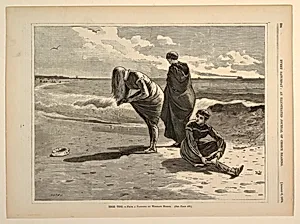
High Tide
August 6, 1870
Classification
figures
Department
Smithsonian Collection
Museum
Smithsonian American Art Museum
Credit
Gift of John Goldsmith Phillips, Jr.
Accession Number
1947-4-33
Rights
Public Domain
About this artwork
Research in Progress
Art Historical Context
Winslow Homer (1836–1910), one of America's foremost realist painters, captured the raw beauty and drama of the natural world in *High Tide*, dated August 6, 1870. Fresh from his Civil War illustrations for *Harper's Weekly*, Homer had begun shifting toward intimate scenes of everyday American life, often featuring the sea's relentless power. This work, housed in the Smithsonian American Art Museum as part of the Smithsonian Collection (gift of John Goldsmith Phillips, Jr.), reflects his growing fascination with coastal themes during the post-war era, a time when leisure and nature offered respite from national upheaval. Classified among "figures," *High Tide* likely depicts human forms engaged with the encroaching sea, embodying Homer's signature realism—precise observation of light, water, and movement without romantic idealization. Though the medium remains under research, Homer's technique around 1870 blended meticulous detail from his printmaking background with emerging plein air influences, making his works feel vividly alive. A snapshot of Gilded Age America, the painting invites reflection on humanity's fragile dance with nature. Homer's beach scenes from this period, including this one, influenced generations, cementing his legacy as chronicler of the American spirit. (198 words)