
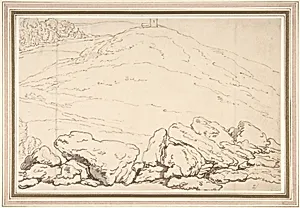
Hilly landscape with rocks
1780–1827
Medium
Pen and ink, brush and wash
Dimensions
sheet: 5 1/2 x 8 1/2 in. (14 x 21.6 cm)
Classification
Drawings
Department
Drawings and Prints
Museum
Metropolitan Museum of Art, New York, NY
Credit
Anonymous gift, 1968
Accession Number
68.549.3
Rights
Public Domain
Tags
Art Historical Context
Thomas Rowlandson's *Hilly Landscape with Rocks* (ca. 1780–1827) is a charming example of the artist's versatility beyond his renowned satirical caricatures. Created with pen and ink, brush, and wash on a modest 5½ × 8½-inch sheet, this drawing captures the rugged beauty of rolling hills and weathered stones. The intimate scale suggests it may have been a personal sketch from Rowlandson's sketchbook, reflecting the British artist's keen eye for the natural world during the late 18th and early 19th centuries. Rowlandson, a master of the Georgian era's print culture, employed fluid pen lines to define contours and textures, while subtle washes add atmospheric depth and shadow, evoking the moody English countryside. This technique was ideal for quick, expressive outdoor studies, aligning with the period's growing fascination with topography and sublime landscapes amid the Romantic movement's rise. Housed in the Metropolitan Museum of Art's Drawings and Prints department as an anonymous 1968 gift, this work highlights Rowlandson's technical prowess and offers visitors a glimpse into everyday artistic practice. Its focus on hills and unembellished nature underscores the era's appreciation for authentic scenery, inviting us to savor the simple poetry of the land.
About the Artist
Thomas Rowlandson · 1756–1827
Thomas Rowlandson (1757–1827) was an English artist and caricaturist whose satirical watercolors and prints captured the social life of Georgian Britain with unparalleled wit and technical mastery. Alongside James Gillray, he is recognized as one of the greatest British graphic artists, and his distinctive flowing line and keen observations have made his work integral to understanding late 18th an...