
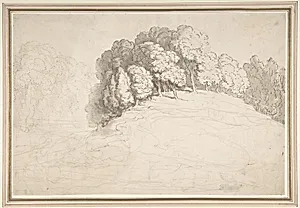
Wooded hillside with deer
1780–1827
Medium
Pen and brown ink, brush and wash, graphite
Dimensions
sheet: 8 3/8 x 12 1/2 in. (21.3 x 31.8 cm)
Classification
Drawings
Department
Drawings and Prints
Museum
Metropolitan Museum of Art, New York, NY
Credit
Anonymous gift, 1968
Accession Number
68.548
Rights
Public Domain
Tags
Art Historical Context
Thomas Rowlandson’s *Wooded Hillside with Deer* (ca. 1780–1827) captures the serene beauty of the British countryside in a delicate drawing that showcases the artist’s versatility beyond his famous satirical caricatures. Best known for his humorous depictions of Regency-era society, Rowlandson (1756–1827) was a master of lively ink work, and this piece reveals his skill in pastoral landscapes. Deer graze peacefully amid rolling hills and dense trees, evoking the picturesque idylls popular in late 18th-century Britain, where artists romanticized nature as an escape from urban life. Executed on a modest sheet measuring 8 3/8 x 12 1/2 inches, the work employs graphite for subtle underdrawing, pen and brown ink for precise lines, and brush with wash for atmospheric depth. This mixed-media technique, common in the Drawings and Prints tradition, allowed Rowlandson to build texture and shadow, lending a sense of depth to the wooded scene. Housed in the Metropolitan Museum of Art thanks to an anonymous gift in 1968, it exemplifies the period’s fascination with topography and wildlife. For visitors, this drawing offers a quiet contrast to Rowlandson’s boisterous satires, highlighting his observational prowess and the era’s growing appreciation for unspoiled landscapes amid the Industrial Revolution’s rise. A charming window into 18th-century artistic practice! (198 words)
About the Artist
Thomas Rowlandson · 1756–1827
Thomas Rowlandson (1757–1827) was an English artist and caricaturist whose satirical watercolors and prints captured the social life of Georgian Britain with unparalleled wit and technical mastery. Alongside James Gillray, he is recognized as one of the greatest British graphic artists, and his distinctive flowing line and keen observations have made his work integral to understanding late 18th an...