
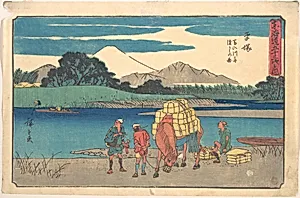
東海道五十三次之内 平塚 馬入川舟渡しの図|Hiratsuka; Banyugawa Funa Watashi no Zu
ca. 1842
Medium
Woodblock print; ink and color on paper
Dimensions
8 27/32 x 13 1/2 in. (22.5 x 34.3 cm)
Classification
Prints
Culture & Period
Japan · Edo period (1615–1868)
Department
Asian Art
Museum
Metropolitan Museum of Art, New York, NY
Credit
Purchase, Joseph Pulitzer Bequest, 1918
Accession Number
JP577
Rights
Public Domain
Tags
Art Historical Context
Utagawa Hiroshige (1797–1858), a master of ukiyo-e woodblock prints, captured the beauty and bustle of Japan's Edo-period travel culture in his renowned series *The Fifty-three of the Tōkaidō* (ca. 1833–1834, with later editions like this one from around 1842). This, *Hiratsuka: Banyugawa Funa Watashi no Zu* ("Hiratsuka: Picture of the Ferry Crossing at Banyū River"), depicts the 11th station along the vital Tōkaidō highway linking Edo (modern Tokyo) to Kyoto. Produced during the Edo period (1615–1868), these affordable prints brought scenic views and daily life to urban audiences, fueling a craze for landscape art. In the scene, sturdy ferries navigate the wide Banyū River, laden with travelers, horses, and porters under a vast sky framed by distant mountains. Hiroshige's genius shines in his atmospheric details—the rippling water, dynamic figures bracing against the current, and subtle color gradients achieved through precise woodblock layering of inks on paper. This 8 27/32 x 13 1/2-inch print exemplifies his poetic realism, blending human activity with nature's grandeur. As part of the Metropolitan Museum of Art's Asian Art collection (Purchase, Joseph Pulitzer Bequest, 1918), it highlights ukiyo-e's cultural role in romanticizing pilgrimage and commerce on Japan's ancient roads, influencing global artists like Van Gogh. A window into 19th-century Japan!
About the Artist
Utagawa Hiroshige · 1826–1869
Utagawa Hiroshige (1797–1858), born Andō Tokutarō, was the last great master of Japanese ukiyo-e woodblock printmaking and one of the most influential landscape artists in history. Born in Edo (modern Tokyo) into a low-ranking samurai family serving as fire wardens, Hiroshige transformed landscape printmaking into a poetic meditation on nature, weather, and everyday life. His revolutionary approac...