
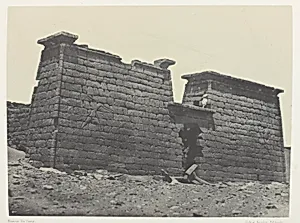
Hémi-Spéos De Séboua, Pylônes; Nubie, plate 98 from the album "Egypte, Nubie, Palestine et Syrie" (1852)
1849/51, printed 1852
Medium
Salted paper print
Dimensions
Image/paper: 16.2 × 21.8 cm (6 7/16 × 8 5/8 in.); Album page: 30 × 43 cm (11 13/16 × 16 15/16 in.)
Classification
salted paper print
Department
Photography and Media
Museum
Art Institute of Chicago
Accession Number
144312
Rights
Public Domain
Art Historical Context
Step into the sun-baked sands of ancient Nubia with Maxime Du's *Hémi-Spéos De Séboua, Pylônes* (plate 98 from *Egypte, Nubie, Palestine et Syrie*, 2). Captured during the French photographer's epic 1849–51 expedition alongside writer Gustave Flaubert, this paper print documents the monumental pylons—towering gateways—of the rock-cut temple at Séboua. Published just a year later, Du Camp's lavish album was among the first to bring calotype photography to a wide audience, blending travelogue with pioneering visual record-keeping. The salted paper process, perfected by William Henry Fox Talbot, involved sensitizing paper with salt and silver nitrate for rich, matte tones that evoke the texture of weathered stone. At 16.2 × 21.8 cm, this intimate yet evocative image preserves Nubian architecture from the reign of Ramesses II, a cultural crossroads of Egyptian and local traditions now largely lost to Lake Nasser's waters post-Aswan Dam. Du Camp's work not only advanced photography as an artistic medium but also safeguarded endangered heritage, offering museum-goers a window into 19th-century exploration and antiquity's enduring allure.
About the Artist
Maxime Du Camp · 1822–present
Maxime Du Camp (1822–1894) was a pioneering French photographer and writer whose adventurous spirit and technical innovation bridged literature and visual art during the mid-19th century. Born in Paris on February 8, 1822, to a prosperous family—his father a successful surgeon—Du Camp received a solid bourgeois education at the Collège Bourbon (now Lycée Condorcet), where he cultivated interests i...