
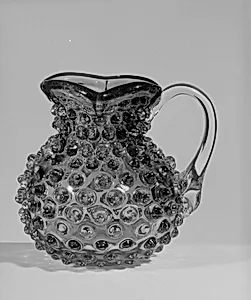
Hobnail Creamer
after 1886
Medium
Pressed cranberry and colorless glass
Dimensions
H. 4 in. (10.2 cm)
Classification
Cream pot
Culture
American
Department
The American Wing
Museum
Metropolitan Museum of Art, New York, NY
Credit
Gift of Mrs. Emily Winthrop Miles, 1946
Accession Number
46.140.429
Rights
Public Domain
Art Historical Context
Nestled in the Metropolitan Museum of Art's American Wing, this charming *Hobnail Creamer* exemplifies the ingenuity of late 19th-century American glassmaking. Crafted by Hobbs, Brockunier and after 1886, the petite vessel stands just 4 inches tall and features pressed cranberry and colorless glass. The vibrant cranberry hue—achieved by adding gold chloride to the molten glass—creates a rich, jewel-like red-purple glow, while the clear glass accents highlight its form. Its hobnail pattern, with rows of raised, rounded knobs mimicking the studs on Victorian boots, adds tactile elegance to this functional tableware. Pressed glass like this was a hallmark of the era's industrial revolution in American manufacturing. Hobbs, Brockunier, based in West Virginia, pioneered affordable yet decorative glassware through molding techniques that allowed mass production without sacrificing beauty. This democratized luxury for middle-class homes, blending utility with ornamentation during the post-Civil War economic boom. The creamer's simple spout and handle made it ideal for serving cream in parlors or at breakfast tables. A generous gift from Mrs. Emily Winthrop Miles in 1946, this piece preserves a slice of everyday American life, showcasing how glassmakers elevated the ordinary into art. Visitors can appreciate its subtle sheen under gallery lights, a testament to the enduring appeal of Victorian craftsmanship.
About the Artist
Hobbs, Brockunier and Company · 1863–1891
**J. H. Hobbs, Brockunier and Company**, a pioneering American glass manufacturer, traces its origins to 1845 when John L. Hobbs and James B. Barnes, both former supervisory employees at the prestigious New England Glass Company in Massachusetts, leased the idle South Wheeling Glass Works in what is now Wheeling, West Virginia. After several reorganizations amid partner changes—including the addit...