
Hodogaya
1865
Medium
Woodblock print; ink and color on paper
Dimensions
9 5/16 x 14 in. (23.6 x 35.5 cm)
Classification
Prints
Culture & Period
Japan · Edo period (1615–1868)
Department
Asian Art
Museum
Metropolitan Museum of Art, New York, NY
Credit
Gift of Lincoln Kirstein, 1959
Accession Number
JP3197
Rights
Public Domain
Tags
Art Historical Context
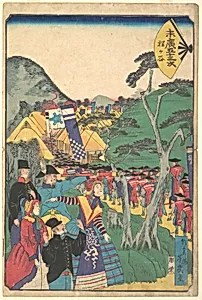
Created in 1865 during Japan’s late Edo period, *Hodogaya* exemplifies the vibrant tradition of ukiyo-e woodblock prints that flourished in the nineteenth century. Utagawa Yoshiiku, a pupil of the celebrated Kuniyoshi, contributed to this popular art form, which combined skilled carving and printing techniques to produce affordable, colorful images for a wide audience. The medium—ink and color on paper—allowed artists to capture fleeting moments of travel, festivals, and daily life along Japan’s historic highways. The scene depicts a lively gathering of women and townspeople amid rolling hills and trees, with fluttering flags suggesting a procession or local celebration near the post station of Hodogaya on the Tōkaidō road. Such views celebrated famous places (*meisho*) while offering viewers a sense of movement and community within a serene landscape. As a gift to the Metropolitan Museum, this print preserves the collaborative spirit of Edo-period printmaking, where artist, carver, and printer worked together to bring Japan’s changing world to life for generations of admirers.
About the Artist
Utagawa Yoshiiku · 1833–1904
Utagawa Yoshiiku (1833–1904) was a prolific Japanese woodblock print artist and journalist who lived through one of the most turbulent and transformative periods in his country's history, the transition from the Edo period through the Meiji Restoration. A student of the celebrated Utagawa Kuniyoshi, Yoshiiku inherited his master's taste for bold compositional drama and dynamic figuration, applying...