
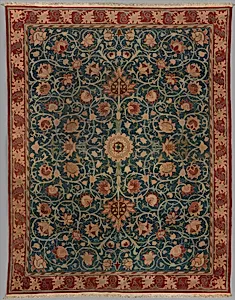
Holland Park carpet
late 19th century
Medium
Wool Turkish (Ghiordes) knot, 25 to the square inch.
Dimensions
Overall: 203 x 156 1/4 in. (515.6 x 396.9 cm)
Classification
Textiles-Rugs
Culture
British, Merton Abbey or Hammersmith
Department
European Sculpture and Decorative Arts
Museum
Metropolitan Museum of Art, New York, NY
Credit
Bequest of Frank A. Munsey, 1927
Accession Number
27.139.3
Rights
Public Domain
Tags
Art Historical Context
Welcome to the Metropolitan Museum of Art's European Sculpture and Decorative Arts gallery, where you'll find the stunning *Holland Park carpet* by William Morris, a cornerstone of the late 19th-century Arts and Crafts movement. Created around the 1880s at Morris's Merton Abbey or Hammersmith workshops in Britain, this monumental wool rug measures over 16 feet by 13 feet, designed to anchor grand interiors with its lush floral motifs—evident in its "Flowers" tag. Morris, a pioneering designer and socialist thinker, championed handmade craftsmanship against the dehumanizing effects of industrial production, drawing inspiration from medieval tapestries and nature to revive authentic decorative arts. What sets this carpet apart is its meticulous construction using the Turkish (Ghiordes) knot, with 25 knots per square inch—a technique borrowed from Ottoman weaving traditions for exceptional durability and intricate detail. Hand-knotted by skilled artisans, it exemplifies Morris & Co.'s commitment to quality and beauty in everyday objects, transforming a functional rug into a work of art. Bequeathed to the Met in 1927 by Frank A. Munsey, it remains a testament to the movement's influence on modern design, inviting us to appreciate the labor and harmony in its blooming patterns.
About the Artist
William Morris · 1834–1896
William Morris (1834–1896) was a British designer, craftsman, writer, and socialist activist who became the most influential figure in the Arts and Crafts movement and one of the most important designers in British history. Born in Walthamstow, Essex, he studied at Oxford, where he formed a lifelong friendship with Edward Burne-Jones and came under the influence of John Ruskin's writings on art, l...