
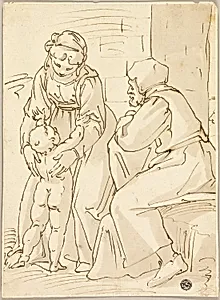
Holy Family
c. 1570
Medium
Pen and brown ink with brush and brown wash, and traces of graphite, on cream laid paper, laid down on tan laid paper
Dimensions
26.5 × 19.3 cm (10 7/16 × 7 5/8 in.)
Classification
ink with wash
Department
Prints and Drawings
Museum
Art Institute of Chicago
Accession Number
109805
Rights
Public Domain
Art Historical Context
Welcome to the Prints and Drawings collection at the Art Institute of Chicago where Luca Cambiaso's *Holy Family* (c. 1570) captivates with its intimate grace. This 16th-century Genoese master, a key figure in Mannerism, depicts the sacred trio—Mary, the Christ Child, and Saint Joseph—in a tender, elongated composition typical of his style. Influenced by Michelangelo, Cambo favored dynamic, stylized figures that convey spiritual depth through fluid lines and expressive poses, making this drawing a prime example of his innovative draftsmanship. Crafted on cream laid paper with pen and brown ink, brush and brown wash, and subtle graphite traces, the work showcases Renaissance drawing techniques at their peak. The brown wash adds soft tonal modeling, enhancing volume and emotion without color, while the paper's texture—laid down on tan laid paper for preservation—highlights its status as a preparatory or independent study. At 26.5 × 19.3 cm, its modest scale invites close contemplation. Cambiaso's renown as a court artist in Genoa and Spain underscores the cultural prestige of such works, bridging religious devotion and artistic virtuosity during the Catholic Reformation era. A gem of Mannerist ingenuity, it reminds us how paper became a canvas for profound piety.
About the Artist
Luca Cambiaso · 1527–1585
Luca Cambiaso (1527–1585) was an Italian painter and draftsman who dominated artistic life in Genoa during the second half of the sixteenth century and became one of the most innovative draftsmen of the Late Renaissance. Born in Moneglia near Genoa, he trained under his father, the painter Giovanni Cambiaso, and demonstrated precocious talent, reportedly completing his first public fresco commissi...