
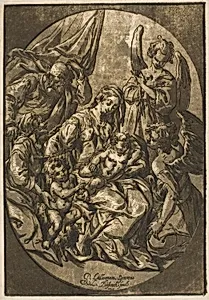
Holy Family in an Oval Frame
1623
Medium
Chiaroscuro woodcut from three blocks, on paper
Dimensions
Image/block: 30.8 × 21.2 cm (12 3/16 × 8 3/8 in.); Sheet: 31.7 × 22.3 cm (12 1/2 × 8 13/16 in.)
Classification
woodcut
Department
Prints and Drawings
Museum
Art Institute of Chicago
Accession Number
104237
Rights
Public Domain
About this artwork
Büsinck worked in Paris from 1623 to 1630, and was the first artist in France to make chiaroscuro woodcuts. He created about twenty-four in that period, mostly of religious or genre subjects by Georges Lallemand. His works show the influence of Hendrik Goltzius.
Art Historical Context
**Holy Family in an Oval Frame (1623) by Ludolphsinck captures a tender moment of the Virgin Mary cradling the Christ Child, with Saint Joseph nearby, framed in an elegant oval. This chiaroscuro woodcut, from three blocks on paper exemplifies early 17th-century Northern European printmaking. Büsinck, a artist active in Haarlem and, drew inspiration from Baroque masters like Caravaggio, emphasizing dramatic light and shadow to evoke spiritual depth and intimacy. The chiaroscuro technique—using a line block for contours and tone blocks for subtle gradations of light and dark—mimics the painterly effects of oil paintings, making woodcuts feel luxurious and three-dimensional. Measuring about 12 x 8 inches, this print from the Art Institute of Chicago's Prints and Drawings collection highlights woodcuts' rise as affordable yet sophisticated art, bridging fine art and popular devotion during the Counter-Reformation. Büsinck's work reflects a time when religious imagery flourished in Protestant and Catholic circles alike, offering the faithful portable icons of solace. Its oval format, popular in prints, enhanced its decorative appeal for homes and altars, blending technical innovation with heartfelt piety.