
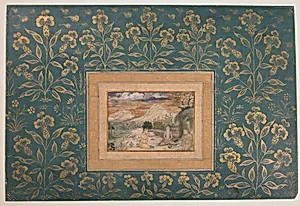
Holy Man with Two Disciples in a Landscape Setting
Unknown Artist
ca. 1640
Medium
Ink, opaque watercolor, and gold on paper
Dimensions
Overall: H. 10 3/16 in. (25.9 cm) W. 15 1/8 in. (38.4 cm) Dimensions of painting: H. 3 in. (7.6 cm) W. 4 3/8 in. (11.1 cm)
Classification
Codices
Department
Islamic Art
Museum
Metropolitan Museum of Art, New York, NY
Credit
Fletcher Fund, 1976
Accession Number
1976.275
Rights
Public Domain
Tags
Art Historical Context
This exquisite miniature painting, *Holy Man with Two Disciples a Landscape Setting*, dates to around 1640 and hails from the rich tradition of Islamic manuscript illumination Created by an unknown artist using ink, opaque watercolor, and on paper, it measures a delicate 3 x 4⅜ inches within a larger folio (10¼ x 15⅛ inches). Housed in the Metropolitan Museum of Art's Islamic department as part of a codex (acquired via the Fletcher Fund in 6), it captures a serene spiritual scene: a holy man accompanied by two disciples amid hills, trees, and a lush landscape, intriguingly incorporating female nudes that add layers of symbolic or narrative depth common in Persianate art. In the 17th century, such works flourished under Safavid Persia or Mughal India, where miniatures served as illuminated pages in codices—lavishly bound books of poetry, history, or religious texts. The opaque watercolors provide vibrant, jewel-like hues, while gold accents lend a divine glow, evoking otherworldly reverence. This intimate scale invited close contemplation, reflecting Islam's emphasis on spiritual introspection in nature. Though the artist's identity remains elusive, the painting's masterful composition highlights the era's technical virtuosity: intricate line work in ink defines figures and foliage, blending human devotion with the sublime environment. A window into Sufi-inspired mysticism, it invites visitors to ponder the interplay of piety, beauty, and the natural world.