
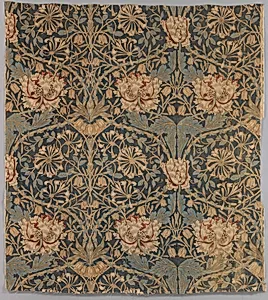
Honeysuckle
design registered 1876, printed 1876–77
Medium
Linen
Dimensions
Overall ("a" confirmed): 67 x 70 in. (170.2 x 177.8 cm); Overall ("b" confirmed): 37 3/4 x 53 1/4 in. (95.9 x 135.3 cm); Overall ("c" confirmed): 60 1/4 x 28 in. (153 x 71.1 cm); Overall ("d" confirmed): 20 3/4 x 53 3/4 in. (52.7 x 136.5 cm); Overall ("e" confirmed): 19 x 49 1/2 in. (48.3 x 125.7 cm); Overall ("f" confirmed): 2 3/4 x 55 in. (7 x 139.7 cm); Overall (assembled): 67 x 60 in. (170.2 x 152.4 cm)
Classification
Textiles-Printed
Culture
British
Department
European Sculpture and Decorative Arts
Museum
Metropolitan Museum of Art, New York, NY
Credit
Theodore M. Davis Collection, Bequest of Theodore M. Davis, 1915
Accession Number
30.95.46a–f
Rights
Public Domain
Tags
Art Historical Context
William Morris's *Honeysuckle*, designed and registered in 1876 and shortly after, exemplifies the British designer's commitment to beauty in everyday interiors. This printed linen textile features repeating motifs of delicate honeysuckle flowers, in soft blues, creams, and greens against a light ground. Comprising six fragments in varying sizes—from a substantial 67 x 70 inches to slender strips—the panels could be assembled into hangings or portieres, measuring about 67 x 60 inches when combined. Part of the Metropolitan Museum of Art's European Sculpture and Decorative Arts collection, it entered via the Theodore M. Davis bequest in 1915. As a leader of the Arts and Crafts movement, Morris rebelled against the mechanized ugliness of Victorian industry, drawing inspiration from medieval craftsmanship and nature's organic forms. His *Honeysuckle* pattern reflects this philosophy, with its sinuous vines and blooms evoking hand-drawn precision achieved through woodblock printing techniques on fine linen—a durable yet luxurious medium ideal for home furnishings. This artwork invites us to appreciate Morris's vision of art for all, where floral abundance transforms simple fabric into timeless elegance, reminding visitors of nature's enduring allure in design.
About the Artist
William Morris · 1834–1896
William Morris (1834–1896) was a British designer, craftsman, writer, and socialist activist who became the most influential figure in the Arts and Crafts movement and one of the most important designers in British history. Born in Walthamstow, Essex, he studied at Oxford, where he formed a lifelong friendship with Edward Burne-Jones and came under the influence of John Ruskin's writings on art, l...