
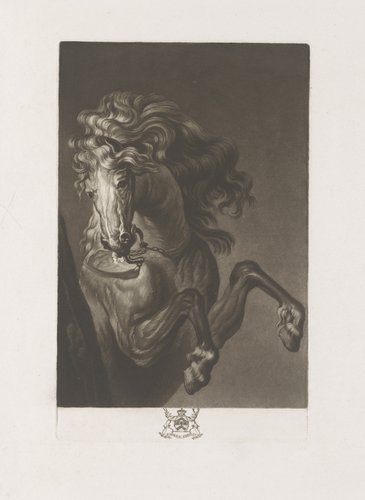
Hoofd en benen van een springend paard
1752 - 1777
Medium
etching
Dimensions
423; 184; 292; 570
Rights
Public Domain
About this artwork
Aankoop uit het F.G. Waller-Fonds
Art Historical Context
Richard Earlom's *Hoofd en benen van een spring paard* (Head and of a Jumping Horse), between 1752 and1777, captures the dynamic motion of a horse in mid-leap through a focused of its head and legs This etching, measuring 292 mm high 184 mm wide, exemplifies th-century British printmaking's fascination with anatomical and equestrian subjects, popular among artists depicting hunting scenes, races, and classical. As a master engraver, Earlom was renowned for his reproductive prints after old masters, blending meticulous line work with a sense of vitality. Etching, the medium here, allowed for fluid, expressive lines etched into a metal plate with acid, enabling detailed textures like the horse's taut muscles and flowing mane—techniques that brought movement to static paper. This work reflects the era's growing interest in naturalism, influenced by Enlightenment studies of anatomy and motion. Acquired through the F.G. Waller Fund, this piece highlights Earlom's technical prowess and the enduring appeal of equine imagery in art, bridging sporting culture and fine print traditions for collectors today.
About the Artist
Richard Earlom · 1728–1794
Richard Earlom (1743–1822) stands as one of the supreme masters of mezzotint engraving in British art history, whose technical virtuosity and dedication to reproductive printmaking brought the works of Old Masters to unprecedented audiences. Born in London on May 14, 1743, Earlom spent his entire career transforming paintings and drawings into prints of extraordinary quality, elevating reproductiv...