
Hooked Rug
c. 1940
Medium
watercolor, graphite, and gouache on paperboard
Dimensions
sheet: 22.9 × 30 cm (9 × 11 13/16 in.)Original IAD Object: 72" wide; 34" long
Classification
Index of American Design
Department
CG-W
Museum
National Gallery of Art, Washington, D.C.
Credit
Index of American Design
Accession Number
1943.8.250
Rights
Public Domain
Art Historical Context
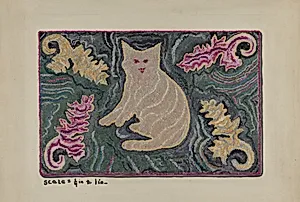
Behold the vibrant *Hooked Rug*, a rendering by Dorothy Kiernan created around 1940. This watercolor, graphite, and gou work on paperboard (22.9 × 30 cm) captures the essence an original hooked rug measuring a generous 72 inches wide by 34 inches. Part of the National Gallery of Art's collection, it belongs to the Index of American (IAD), a trove of Depression-era documentation. The IAD, launched under the Works Progress Administration's Federal Art Project in the 1930s, employed artists like Kiernan to produce precise, colorful depictions of everyday American folk objects. These renderings preserved vanishing crafts for posterity, celebrating the ingenuity of ordinary makers amid economic hardship. Kiernan's piece exemplifies this mission, translating the rug's textured, folkloric patterns—likely floral or geometric motifs pieced from recycled fabrics—into a luminous, detailed study. Hooked rugs, a beloved American craft from the 19th and early 20th centuries, were crafted by pulling yarn or cloth strips through a coarse backing with a simple hook, often by women in rural homes. This artwork highlights their cultural role as affordable, personal art, blending utility with storytelling and evoking a bygone era of resourcefulness and creativity. A delightful window into America's vernacular design heritage!