
Piece
Unknown Artist
18th century
Medium
Silk / Compound weave
Dimensions
2 1/2 in. × 4 in. (6.4 × 10.2 cm)
Classification
Textiles-Woven
Culture & Period
Japan · Edo period (1615–1868)
Department
Asian Art
Museum
Metropolitan Museum of Art, New York, NY
Credit
Gift of Kihei Hattori, in memory of his father, Kihei Hattori, 1920
Accession Number
20.148.1015
Rights
Public Domain
Tags
Art Historical Context
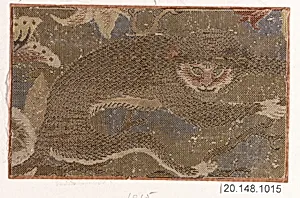
This exquisite silk textile fragment, titled simply *Piece*, hails from18th-century Japan during the Edo period (161–1868), a time of relative peace and cultural flourishing under the Tokugawa shogunate. Measuring just 2½ × 4 inches (6.4 × 10.2 cm), thisutive woven work showcases the mastery of Japanese textile artisans, now housed in the Metropolitan Museum of Art Asian Art Department. Gift in 1920 byhei Hattori in memory of father, it exemplifies the intricate craftsmanship of the era, preserved as a rare survivor of everyday luxury fabrics. Crafted in a compound weave—a sophisticated technique layering multiple warp and weft systems to create complex patterns and textures—the medium highlights silk's prized status in Edo Japan. This method allowed for rich, multidimensional designs that rivaled painting, often used in kimonos, furnishings, or ceremonial items. The motif of monkeys, playfully rendered, draws from Japanese folklore where these creatures symbolize mischief, protection, and good fortune, evoking a whimsical yet profound cultural resonance. Though the artist remains unknown, this fragment invites us to appreciate the anonymous skill of Edo weavers, whose innovations influenced global textile arts and offer a window into Japan's vibrant material culture.