
Hooping Crane
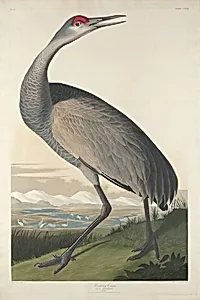
Medium
hand-colored engraving and aquatint on Whatman wove paper
Dimensions
plate: 97 x 64.8 cm (38 3/16 x 25 1/2 in.) sheet: 100.7 x 68.2 cm (39 5/8 x 26 7/8 in.)
Classification
Department
CG-W
Museum
National Gallery of Art, Washington, D.C.
Credit
Gift of Mrs. Walter B. James
Accession Number
1945.8.261
Rights
Public Domain
Art Historical Context
Behold the majestic *Whooping Crane* (often spelled "Hooping" in early texts), a stunning hand-colored engraving and aquatint by Robert Havell after John James Audubon, created in 1835. This monumental print, measuring nearly 40 by 27 inches on fine Whatman wove paper, hails from Audubon's groundbreaking *The Birds of America* (1827–1838), a lavish double-elephant folio series that depicted North American birds at life size. Audubon, a pioneering naturalist and artist, posed his subjects dramatically amid natural habitats, blending scientific precision with artistic flair to revolutionize ornithological illustration during the early 19th-century Romantic era. Havell's masterful techniques—engraving for intricate feather details and aquatint for soft tonal gradients—elevated Audubon's watercolors into vibrant, museum-quality prints. Hand-coloring by skilled artisans added lifelike luminosity, making each crane seem poised to take flight. Produced in London, these plates were subscription-funded luxuries for Europe's elite, symbolizing America's wild frontiers. Today, housed in the National Gallery of Art as a gift from Mrs. Walter B. James, this work highlights Audubon's enduring legacy in conservation— the whooping crane, once nearly extinct, endures as a testament to his visionary documentation. A must-see for bird lovers and print enthusiasts alike!
About the Artist
Robert Havell after John James Audubon
Robert Havell Jr., born on November 25, 1793, in Reading, Berkshire, England, was the son of renowned engraver and publisher Robert Havell Sr. and Lydia Miller Phillips. Growing up in a family of artists that included notable engravers and etchers, he trained under his father, mastering aquatint techniques early on. Though briefly estranged from the family business, Havell reconciled with his fath...