
Hope (Hoffnung), from The Seven Virtues
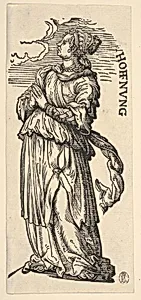
Medium
Woodcut; third state of three (Hollstein)
Dimensions
Sheet: 6 13/16 × 3 1/16 in. (17.3 × 7.7 cm)
Classification
Prints
Department
Drawings and Prints
Museum
Metropolitan Museum of Art, New York, NY
Credit
Gift of Henry Walters, by exchange, 1931
Accession Number
31.31.5
Rights
Public Domain
Tags
Art Historical Context
Hans Burgkmair the Elder (1473–1531), a master woodcutter from Augsburg, created *Hope (Hoffnung)* as part of his series *The Seven Virt*, embodying the Christian theological and cardinal virtues. This small woodcut, measuring just 6 13/16 × 3 1/16 inches, captures the virtue of Hope in a elegant profile view of a woman, a common Renaissance motif symbolizing aspiration and faith. Produced in the third and final state as cataloged by Hollstein, it reflects refinements in printing, likely including added details or tonal effects achieved through skilled block-cutting. Woodcuts like this were revolutionary in the early 16th century, transforming prints from mere illustrations into fine art comparable to paintings. Burgkmair, influenced by the German Renaissance and contemporaries like Albrecht Dürer, excelled in intricate line work that conveyed texture and depth on wood blocks. Affordable and reproducible, these prints spread moral and allegorical imagery across Europe, making virtues accessible to a wide audience beyond the elite. Today, housed in the Metropolitan Museum of Art's Drawings and Prints department (gift of Henry Walters, 1931), *Hope* invites us to reflect on enduring human ideals. Its delicate profile whispers resilience amid uncertainty—a timeless reminder of Burgkmair's craft bridging art and spirituality.
About the Artist
Hans Burgkmair · 1473–1531
Hans Burgkmair the Elder (1473–1531) was a German painter and printmaker who became one of the leading artists of the Renaissance in Augsburg. Born into a family of painters — his father, Thoman Burgkmair, was a respected artist — he likely received his initial training in his father's workshop. He may also have studied with Martin Schongauer in Colmar, and a probable visit to Italy around 1507 ex...