
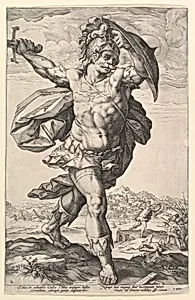
Horatius Cocles, from "The Roman Heroes"
Medium
Engraving; second state
Dimensions
14 1/2 x 9 5/16 in. (36.9 x 23.7 cm)
Classification
Prints
Department
Drawings and Prints
Museum
Metropolitan Museum of Art, New York, NY
Credit
The Elisha Whittelsey Collection, The Elisha Whittelsey Fund, 1949
Accession Number
49.97.690
Rights
Public Domain
Tags
Art Historical Context
Behold *Horatius Cocles*, a dynamic engraving from Hendrick Goltzius's series *The Roman Heroes (1585–86), produced in 1586. This second-state impression captures the legendary Roman warrior Publius Horatius Cocles single-handedly defending the Pons Sublicius bridge against Etruscans around 508 BCE. Goltzius, a masterful Dutch Mannerist engraver (1558–1617), drew from ancient texts like Livy's *History of Rome* to revive classical heroism during the Dutch Revolt, inspiring Renaissance viewers with tales of bravery and sacrifice. Goltzius's virtuosic technique shines here: his innovative "swelling line"—bold, undulating strokes mimicking brushwork—creates dramatic chiaroscuro and muscular torsion, blurring the line between print and painting. At 14½ × 9⅜ inches, the composition thrusts Horatius forward, shield raised and sword hilt gripped, embodying stoic resolve amid chaos. Part of a six-print series, it exemplifies the Northern Mannerist fascination with antiquity, anatomy, and expressive line, influencing generations of printmakers. Housed in The Metropolitan Museum of Art's Drawings and Prints department (Elisha Whittelsey Collection, 1949), this work not only showcases engraving's potential as high art but also bridges classical myth and 16th-century humanism, reminding us of timeless valor.
About the Artist
Hendrick Goltzius · 1558–1617
Hendrick Goltzius (1558–1617) was the most celebrated engraver of the Northern Renaissance and a pivotal figure in Dutch Mannerism. Born near the German-Dutch border, Goltzius transformed printmaking into a virtuoso art form through his revolutionary 'swelling line' technique, where the burin was manipulated to create lines of varying thickness that produced unprecedented tonal effects and three-d...