
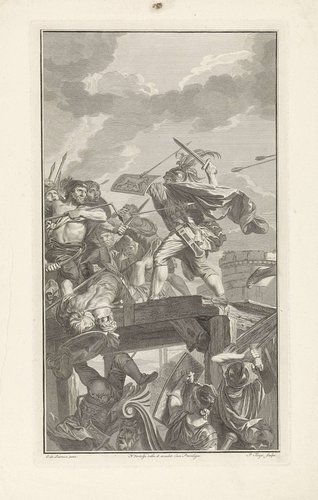
Horatius Cocles verdedigt zich op de brug
1737
Medium
etching
Dimensions
247; 432
Rights
Public Domain
About this artwork
Gift of M. Hudig
Art Historical Context
In the etching *Horatius Cocles verded zich op de brug* (1737), Dutch artist Pieter Tanjé captures a timeless tale of Roman heroism. The title translates to "Horatius Coc Defends Himself on the Bridge," depicting the legendary warrior single-handedly holding off Etruscan invaders at Rome's Pons Sublicius 508 BCE. According to ancient historian Livy, Cocles' brave stand allowed his comrades to destroy the bridge behind him, saving the city from invasion. This dramatic scene, rendered in intricate lines, embodies virtues of courage and self-sacrifice that resonated in 18th-century Europe. Tanjé, a prolific engraver active in Rotterdam, specialized in historical and mythological subjects, often reproducing famous paintings through printmaking. Created as an etching—a technique using acid to etch designs into a metal plate—this work showcases the medium's precision for conveying motion and emotion in large-scale formats (432 × 247 mm). Etchings like this made grand narratives accessible, democratizing art for collectors and scholars amid growing neoclassical interest in antiquity. Generously gifted by M. Hudig, this print highlights Tanjé's mastery of light, shadow, and dynamic composition, inviting visitors to ponder how ancient legends inspired Enlightenment-era ideals of heroism. A stirring reminder of individual valor in the face of overwhelming odds!
About the Artist
Pieter Tanjé · 1706–1761
**Pieter Tanjé (1706–1761)** was a Dutch reproductive engraver active in the eighteenth century. Born in Bolsward, he initially worked as a shipmate on the shipping service between his hometown and Amsterdam. In his spare time, he engraved designs for snuff boxes, an activity that proved so successful that it led to his artistic training. Encouraged by Jacob Folkema, Tanjé enrolled at the age of ...