
Horse
17th–18th Century
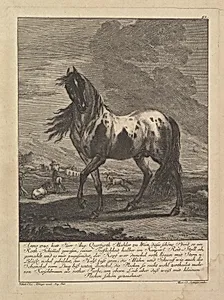
Medium
Etching
Dimensions
sheet: 15 5/8 x 11 7/16 in. (39.7 x 29.1 cm) plate: 13 3/4 x 10 3/16 in. (34.9 x 25.8 cm) image: 12 11/16 x 9 1/8 in. (32.3 x 23.2 cm)
Classification
Prints
Department
Drawings and Prints
Museum
Metropolitan Museum of Art, New York, NY
Credit
Bequest of Phyllis Massar, 2011
Accession Number
2012.136.756
Rights
Public Domain
Tags
Art Historical Context
Johann Elias Ridinger’s *Horse*, an etching from the 17th18th century, exemplifies artist’s mastery of animal portraiture during the Baroque era. This finely detailed print, measuring approximately 15⅝ × 11½ inches on the sheet, captures the majestic form of its equine subject with remarkable precision. Produced through the etching technique—where acid bites into a metal plate to create intricate lines—Ridinger’s work allowed for subtle textures and dynamic shading, making it a standout in reproductive printmaking. Ridinger, a prolific German engraver and publisher active in Augsburg, specialized in equestrian themes, reflecting Europe’s fascination with horses as symbols of power, speed, and nobility in an age of cavalry warfare and aristocratic riding. His prints often served as studies for painters or decorative pieces, blending scientific observation with artistic flair. This piece likely belongs to one of his renowned series celebrating the horse’s anatomy and grace. Housed in the Metropolitan Museum of Art’s Drawings and Prints department through the 2011 bequest of Phyllis Massar, *Horse* invites visitors to appreciate the technical virtuosity of 18th-century printmaking and its role in documenting cultural icons. A timeless tribute to equine beauty, it reminds us of art’s power to elevate the everyday.
About the Artist
Johann Elias Ridinger · 1698–1767
Johann Elias Ridinger (1698–1767) was born in Ulm into an artistic family, the son of scribe and artist Johann Daniel Ridinger and Regina Catharina Miller. He received his initial training in Ulm under the painter Christoph Resch, who instructed him in perspective, geometry, and architecture while assigning preparatory tasks like painting wax models. Around 1713, Ridinger moved to Augsburg, where ...