
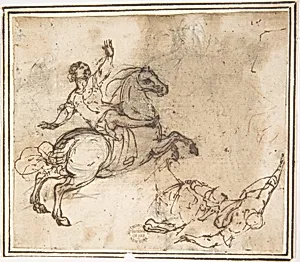
Horse and Rider
1624–63
Medium
Pen and brown ink over black chalk
Dimensions
4-9/16 x 5-3/8 in. (11.6 x 13.6 cm)
Classification
Drawings
Department
Drawings and Prints
Museum
Metropolitan Museum of Art, New York, NY
Credit
Gift of Cornelius Vanderbilt, 1880
Accession Number
80.3.345
Rights
Public Domain
Tags
Art Historical Context
**Horse and Rider** by Francesco Allegrini ( 1624–63) is a captivating preparatory drawing from the Italian Baroque era, showcasing the artist's skillful command of line and form. Executed in pen and brown ink over black, this intimate sheet measures just 4-9/16 x 5-3/8 inches (11.6 x 13.6 cm), typical of studies meant for larger compositions or personal exploration. Allegrini, a draughtsman from Gubbio known for his dynamic figures, captures the tension and movement of a rider astride powerful horse, evoking the classical equestrian themes revived during the 17th century. The technique—black chalk for initial blocking followed by precise brown ink hatching—highlights Baroque interests in anatomy, light, and shadow, influenced by masters like Caravaggio. Such drawings were vital in workshops, serving as models for paintings or engravings, and reflect the period's fascination with heroism and motion. The tags "Men" and "Horses" underscore its focus on human-animal synergy, a motif echoing ancient sculptures and Renaissance ideals. A generous gift from Cornelius Vanderbilt in 1880, this work resides in the Metropolitan Museum of Art's Drawings and Prints department. Visitors will appreciate its delicate energy, a window into an artist's creative process amid Italy's artistic golden age.
About the Artist
Francesco Allegrini · 1615–1679
Francesco Allegrini (c. 1615/20–after 1679), born likely in Rome to the painter Flaminio Allegrini from Cantiano near Gubbio, emerged from a family of artists that included his sister, Anna Angelica Allegrini. He trained under Giuseppe Cesari, known as the Cavalier d’Arpino, around 1638–40, before entering the studio of Pietro da Cortona, whose dynamic Baroque style profoundly shaped his own. Elec...