
Horse and Rider
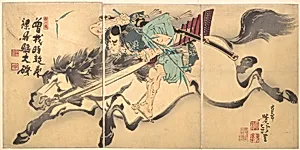
Medium
Triptych of woodblock prints; ink and color on paper
Dimensions
14 1/4 x 29 5/8 in. (36.2 x 75.2 cm)
Classification
Prints
Culture
Japan
Department
Asian Art
Museum
Metropolitan Museum of Art, New York, NY
Credit
Gift of Francis M. Weld, 1948
Accession Number
JP3133
Rights
Public Domain
Tags
Art Historical Context
**Horse and Rider** is a striking triptych woodblock by Tsukioka Yoshitoshi (1839–1892), one of Japan's most renowned ukiyo-e artists the late 19th century. Created using ink and color on paper, work measures 14 1/4 x 29 5/8 inches, with the triptych format allowing for a panoramic composition that unfolds across three panels. Acquired as a gift to the Metropolitan Museum of Art 1948, it resides in the Asian Art department exemplifying the precision and vibrancy of traditional Japanese printmaking. Yoshitoshi, often called the last great master of ukiyo-e, specialized in dramatic scenes of warriors, ghosts, and historical figures, blending meticulous line work with bold colors to evoke motion and emotion. The triptych medium was ideal for depicting dynamic subjects like the horse and rider suggested by the title and tags—likely portraying a samurai or nobleman in mid-gallop, capturing the speed and power central to Japanese equestrian culture. Woodblock printing techniques, involving carved cherry wood blocks for each color layer, highlight the artistry's collaborative nature between carvers, printers, and publishers. This piece reflects Japan's Meiji-era transition, where ukiyo-e bridged Edo-period traditions with modern influences. Visitors will appreciate its cultural resonance: horses symbolized status and valor in samurai lore, making **Horse and Rider** a vivid window into feudal Japan's heroic ideals. (198 words)
About the Artist
Tsukioka Yoshitoshi · 1839–1892
Tsukioka Yoshitoshi was born on April 30, 1839, in the Shimbashi district of Edo, the city that would become Tokyo. At the age of eleven he was apprenticed to Utagawa Kuniyoshi, one of the great masters of the Japanese woodblock print, who gave the boy the artist name 'Yoshitoshi' as a mark of lineage within the Utagawa School. From Kuniyoshi, Yoshitoshi absorbed the full tradition of ukiyo-e — th...