
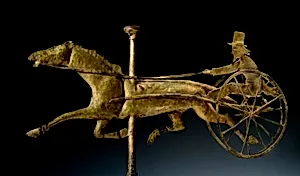
Horse and Uncle Sam Driver
1850-1860
Medium
Decorative Arts
Classification
Decorative Arts
Department
Smithsonian Collection
Museum
Smithsonian American Art Museum
Credit
Smithsonian American Art Museum, Museum purchase
Accession Number
1966.45
Rights
Public Domain
Tags
About this artwork
The first known weather vane sat on top of the Tower of the Winds in Athens during the first century BC. The rooster weather vane, or weathercock, appeared a thousand years later when a papal edict announced that every church must carry the symbol of a rooster. This was to remind the faithful of Peter's betrayal of Jesus, who said that the cock would not crow until Peter had denied him three times. In the nineteenth century, people made weather vanes showing everyday activities. Horses represent...
Art Historical Context
Perched atop barns and steeples across 19th-century America, vanes like *Horse and Uncle Sam Driver served both practical and decorative purposes. Crafted by an unidentified American artisan between 1850 and 1860, this charming piece from the Smithsonian American Art Museum a spirited horse pulling a cart, guided by the iconic Uncle Sam figure in his top hat. As a functional ornament, it swiveled with the wind to indicate direction blending everyday utility with folk artistry in the Decorative Arts tradition. Weather vanes trace their roots to the first century BC Tower of the Winds in Athens, evolving into symbolic roosters on churches by the Middle Ages—a papal reminder of Peter's denial of Jesus. By the 1800s, American makers shifted to lively scenes of daily life, with horses embodying transportation, sport, and social prestige. Record-winning racehorses were favorites, but this vane's Uncle Sam driver adds a patriotic flair, capturing mid-19th-century national pride just before the Civil War. Today, acquired through museum purchase, it exemplifies vernacular craftsmanship—likely sheet metal, hand-cut and gilded for visibility. A delightful window into antebellum America, it invites us to imagine windswept farms where function met whimsy.
About the Artist
Unidentified (American) ( ) · 1851 –1899
1851–1899