
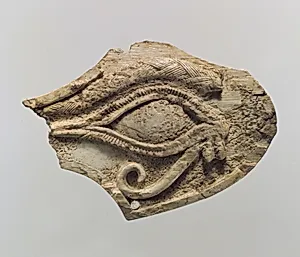
Horse blinker carved in relief with a wedjat eye
Unknown Artist
ca. 8th century BCE
Medium
Ivory
Dimensions
3.23 x 2.2 x 0.31 in. (8.2 x 5.59 x 0.79 cm)
Classification
Ivory/Bone-Equestrian
Culture & Period
Assyrian · Neo-Assyrian
Department
Ancient Near Eastern Art
Museum
Metropolitan Museum of Art, New York, NY
Credit
Rogers Fund, 1960
Accession Number
60.145.4
Rights
Public Domain
Tags
Art Historical Context
This delicate ivory horse blinker, in low relief with a prominent wedjat eye, hails from the Neo-Assyrian period around the 8th century. Crafted for elite equestrian use—likely on war chariots or cavalry mounts—it measures just over 3 inches wide, a testament to the Assyrians' mastery of miniature sculpture. The Neo-Assyrian Empireca. 911–609 BCE) dominated the Ancient Near East through military innovation, and such gear equipped their formidable horse-drawn forces, symbolizing imperial power and mobility. The wedjat eye, an ancient Egyptian motif adopted by Assyrians through cultural exchange, depicts the restored eye of the god Horus. Here, it serves as a protective amulet, warding off evil and ensuring safe vision forward amid battle's chaos—blinkers restricted peripheral sight to keep horses focused. Ivory, a luxury material sourced from elephant tusks, was prized for its creamy smoothness, allowing fine detailing through incising and polishing techniques that highlight the eye's almond shape and protective aura. On view in the Metropolitan Museum of Art's Ancient Near Eastern Art department (acquired via Rogers Fund, 1960), this artifact reveals how everyday military objects blended utility with spirituality, offering a glimpse into Assyrian beliefs in divine safeguarding during conquest.