
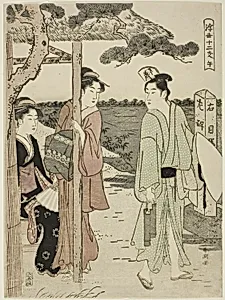
Horse, from the series "Twelve Hours of the Floating World (Ukiyo juni shi)"
c. 1780/1801
Medium
Color woodblock print; oban
Dimensions
25.7 × 19.2 cm (10 1/8 × 7 9/16 in.)
Classification
woodblock print
Department
Arts of Asia
Museum
Art Institute of Chicago
Accession Number
22858
Rights
Public Domain
Art Historical Context
Katsukawa Shunchô *Horse, from the series "Twelve of the Floating World (kiyo juni shi)" captures the vibrant spirit of Edo-period Japan (c. 1780–1801). As a master of ukiyo-e—"pictures of the floating world"—Shunchô specialized in depicting the fleeting pleasures of urban life, from geisha and actors to everyday scenes. This color woodblock print, in the popular oban format (about 25.7 × 19.2 cm), belongs to a series likely illustrating the twelve traditional Chinese zodiac animals, each tied to two hours in the Japanese day-night cycle. The majestic horse evokes the dynamic energy of the 11 a.m.–1 p.m. hour (Horse time), blending whimsy with cultural symbolism. Ukiyo-e prints like this were revolutionary for their accessibility, produced via intricate woodblock techniques: artisans carved separate blocks for each color, layering vivid hues of vermilion, indigo, and green to create depth and movement. Shunchô's fluid lines and delicate shading highlight the horse's graceful form against a stylized background, reflecting the genre's emphasis on beauty and transience. Mass-produced yet artistic, these prints democratized art for merchants and commoners in bustling Edo (modern Tokyo). Housed in the Art Institute of Chicago's Arts of Asia department, this work exemplifies ukiyo-e's enduring influence on global art, from Impressionism to pop culture. Imagine the thrill of owning a slice of the floating world—ephemeral, elegant, and alive with motion!
About the Artist
Katsukawa Shunchô · 1780–1801
Katsukawa Shunchō was a Japanese designer of ukiyo-e woodblock prints active from approximately 1780 to 1795, one of the most graceful practitioners of the art of bijinga — pictures of beautiful women. He trained in the studio of Katsukawa Shunshō, the founding master of the Katsukawa School, whose pupils also included the young Hokusai. Shunshō's school was primarily known for realistic portraits...