
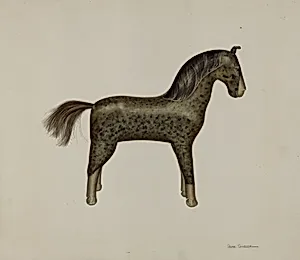
Horse
c. 1939
Medium
watercolor and graphite on paper
Dimensions
overall: 35 x 40.4 cm (13 3/4 x 15 7/8 in.) Original IAD Object: 9" high; 9" long
Classification
Index of American Design
Department
CG-W
Museum
National Gallery of Art, Washington, D.C.
Credit
Index of American Design
Accession Number
1943.8.15599
Rights
Public Domain
Art Historical Context
Selma Sandler's *Horse* (c. 1939) is a captivating watercolor and graphite rendering on paper, measuring 35 x 40.4 cm, created as part of the Index of Design. This federal project, launched under the Works Progress Administration (WPA) during the Great Depression, employed artists to meticulously document everyday American folk art and design objects through precise, colorful drawings. Sandler's depiction captures a small carved wooden horse—originally 9 inches high long—highlighting the charm of vernacular craftsmanship from America's cultural heritage. The Index aimed to preserve and celebrate the nation's artistic traditions amid economic hardship, producing over 15,000 such works now housed in institutions like the National Gallery of Art. Watercolor's fluid transparency paired with graphite's fine lines allowed Sandler to convey the horse's three-dimensional form, texture, and subtle patina with scientific accuracy and artistic flair, bridging documentation and aesthetic appreciation. This piece reflects the era's renewed interest in folk art as a symbol of American identity, evoking the simplicity and vitality of rural life. Visitors will appreciate how Sandler's skilled hand revives a humble object, reminding us of the enduring creativity in everyday American design.
About the Artist
Selma Sandler · 1917–2005
Selma Sandler (1917–2005) was an American artist whose meticulous watercolor renderings played a vital role in documenting the nation's folk art heritage during the Great Depression. Born on March 18, 1917, she contributed to the Index of American Design, a Works Progress Administration (WPA) project under the Federal Art Project that ran from 1935 to 1942. This ambitious endeavor employed artists...