
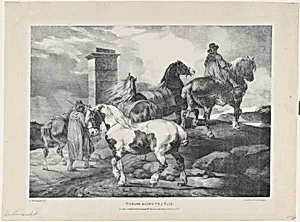
Horses going to a Fair
Medium
Lithograph
Dimensions
Sheet: 12 3/4 × 17 1/8 in. (32.4 × 43.5 cm)
Classification
Prints
Department
Drawings and Prints
Museum
Metropolitan Museum of Art, New York, NY
Credit
Rogers Fund, 1917
Accession Number
17.41.9
Rights
Public Domain
Tags
Art Historical Context
Created in 1821, *Horses Going to a Fair* showcases Théodore Géricault’s masterful command of equine anatomy and movement. A leading figure of French Romanticism, Géricault frequently turned to horses as subjects that embodied energy, nobility, and untamed spirit. This lithograph, printed by Charles Joseph Hullmandel and published by Rodwell & Martin in London, captures a procession of men and horses making their way to market—a scene alive with rhythmic motion and everyday drama. Lithography, a relatively new printmaking technique at the time, allowed Géricault to achieve the rich tonal contrasts and fluid lines usually associated with drawings. The medium’s ability to reproduce spontaneous, sketch-like effects made it ideal for conveying the vitality of his subject. Produced during Géricault’s visit to England, the print reflects both his fascination with British sporting culture and the growing popularity of affordable art for a wider audience. Today in the Metropolitan Museum’s collection, the work offers a vivid glimpse into early nineteenth-century life while highlighting Géricault’s enduring influence on how artists represent animals in motion.
About the Artist
Théodore Gericault|Charles Joseph Hullmandel|Rodwell & Martin · 1791–1824
Théodore Géricault, born Jean-Louis André Théodore Géricault on September 26, 1791, in Rouen, France, into a prosperous family—his father a lawyer turned tobacco merchant and his mother from a line of growers—moved to Paris around 1797. Displaying early artistic promise, recognized by painter Jean-Louis Laneuville, he began formal training in 1808 under Carle Vernet, mastering English sporting art...