
Horses in a Landscape
1924
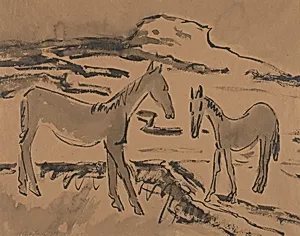
Medium
brush and black ink with gray wash on brown paper
Dimensions
overall: 44.7 x 55 cm (17 5/8 x 21 5/8 in.)
Classification
Drawing
Department
CG-W
Museum
National Gallery of Art, Washington, D.C.
Credit
Gift of Mr. Parker Lesley
Accession Number
1982.28.3
Rights
Public Domain
Art Historical Context
Max Pechstein's *Horses in a Landscape* (1924) captures the raw energy of nature through a dynamic drawing in brush and black ink with gray wash on brown paper Measuring 44.7 x 55 cm, this work from the National Gallery of's collection—generously gifted by Mr. Parker Lesleyshowcases the German artist's mastery of monochrome techniques. The warm brown paper serves as a natural mid-tone ground, allowing the fluid ink strokes and subtle gray washes to evoke depth, movement, and atmospheric light in the pastoral scene. As a key figure in the Expressionist movement and co-founder of the revolutionary Die Brücke group, Pechstein often drew inspiration from primal forces and simplified forms, influenced by his travels and fascination with non-Western art. Created in the Weimar Republic era, post-World War I, this drawing reflects a yearning for harmony amid social upheaval, with galloping horses symbolizing vitality and freedom against a rugged landscape. The piece highlights Pechstein's versatility beyond his vibrant oil paintings, demonstrating how ink and wash could convey emotional intensity. A testament to early 20th-century draftsmanship, it invites viewers to appreciate the spontaneity of the brushwork, where every stroke pulses with life.
About the Artist
Max Pechstein · 1881–1955
Hermann Max Pechstein (1881–1955) was born in Zwickau, Germany, the son of a craftsman in the textile industry. He trained as a decorative painter in his home city before enrolling at the School of Applied Arts in Dresden and then transferring to the Royal Academy of Fine Arts, where he studied under the painter Otto Gussmann. His early exposure to the work of Vincent van Gogh proved decisive in d...