
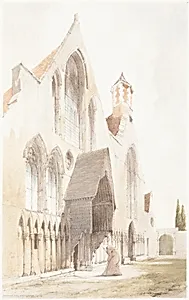
Hospice des Viellards, Gand
Medium
color lithograph on wove paper
Dimensions
image: 27.1 x 17 cm (10 11/16 x 6 11/16 in.) sheet: 35.5 x 53.9 cm (14 x 21 1/4 in.)
Classification
Department
CG-E
Museum
National Gallery of Art, Washington, D.C.
Credit
Gift of Ruth Cole Kainen
Accession Number
2005.145.7.b
Rights
Public Domain
Art Historical Context
Thomas Shotter Boys created this evocative color lithograph 1839, capturing the Hospice des Vieillards, a historic charitable institution for the elderly in Ghent, Belgium. The scene offers a charming glimpse of 19th-century European architecture, with its detailed facade and surrounding urban elements rendered in soft, harmonious tones. As a print on wove paper, it reflects the era’s growing interest in accessible views of notable European landmarks. Boys was a skilled British artist who embraced lithography, a technique invented in the late 18th century that allowed artists to draw directly on stone for rich, layered color effects. This medium was particularly valued for its ability to reproduce delicate architectural details and atmospheric qualities, making works like this one popular among collectors and travelers seeking souvenirs of their journeys. Measuring just over 10 by 6 inches in the image area, the print demonstrates how color lithography bridged fine art and wider audiences during the Romantic period. Today it resides in the National Gallery of Art’s collection as a gift, preserving a moment of quiet civic pride from 19th-century Belgium.
About the Artist
Thomas Shotter Boys · 1803–1874
Thomas Shotter Boys was born on 2 January 1803 in Pentonville, London, and received his first professional training as an apprentice to the engraver George Cooke. When his apprenticeship concluded he crossed the Channel to Paris, a move that would transform his artistic direction entirely. There he encountered Richard Parkes Bonington, the brilliant English watercolourist whose fresh, luminous ren...