
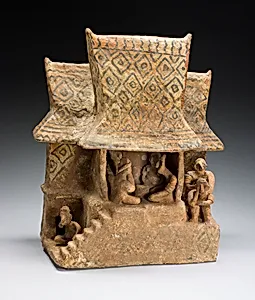
House Model with Ritual Feast
100 BCE–300 CE
Medium
Earthenware and pigment
Dimensions
24.7 × 27.8 × 28.8 cm (9 3/4 × 11 × 11 3/8 in.)
Classification
earthenware
Department
Arts of the Americas
Museum
Art Institute of Chicago
Accession Number
120440
Rights
Public Domain
Art Historical Context
This earthenware house model from Nayarit, created between 100 BCE and 300 CE, offers a vivid glimpse into the domestic and ceremonial life of ancient western Mexico. Crafted from clay and enhanced with pigment, the sculpture captures a multi-room dwelling filled with figures gathered for a ritual feast. Such models were commonly placed in shaft tombs, serving as offerings that reflected the social world of the deceased and their beliefs about community and the afterlife. The artwork highlights the sophisticated ceramic traditions of the Nayarit culture, where artists skillfully modeled architecture, human activity, and symbolic details in three dimensions. The scene likely represents important gatherings that reinforced social bonds and spiritual practices, providing modern viewers with rare insights into pre-Columbian daily rituals. Its compact scale and lively composition make it both an intimate portrait of ancient life and a testament to the enduring power of clay to preserve cultural memory. Housed in the Art Institute of Chicago’s Arts of the Americas collection, this piece invites visitors to appreciate the creativity and worldview of Nayarit artisans from over two millennia ago.