
Household Furniture and Interior Decoration
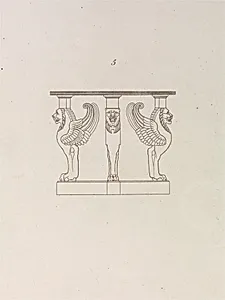
Medium
Engraving and etching
Dimensions
18 1/2 x 12 x 1 in. (47 x 30.5 x 2.5 cm)
Classification
Books|Ornament & Architecture
Department
Drawings and Prints
Museum
Metropolitan Museum of Art, New York, NY
Credit
Harris Brisbane Dick Fund, 1930
Accession Number
30.48.1
Rights
Public Domain
Tags
Art Historical Context
**Household Furniture and Interior Decoration**1807) is a seminal design manual by Thomas Hope, a visionary British architect and collector whose passion for ancient styles shaped Regency-era aesthetics. Published by Longman, Hurst, Rees and Orme and printed by Thomas Bensley, volume exemplifies the Neoclassical and Egyptian Revival movements, blending Greco-Roman grandeur with exotic Egyptian motifs like sphinxes. Hope drew from his vast collection of antiquities to propose innovative furniture and interiors, making sophisticated design accessible to the emerging middle class amid Britain's industrial boom. Rendered in precise engravings and etchings—a medium ideal for reproducing intricate architectural details and ornamental patterns—the book's plates showcase elegant chairs, opulent interiors, and symbolic sphinxes. These techniques allowed for fine lines and tonal depth, capturing textures from carved wood to gilded accents with remarkable fidelity. Measuring 18½ x 12 x 1 inches, it served as both a practical guide and aspirational catalog. Housed in The Metropolitan Museum of Art's Drawings and Prints department (Harris Brisbane Dick Fund, 1930), this work holds enduring cultural importance. It influenced designers across Europe and America, bridging antiquity with modernity and fueling the 19th-century taste for historicism in domestic spaces. Visitors will appreciate how Hope's vision transformed everyday households into temples of style.
About the Artist
Thomas Hope|Thomas Bensley|Longman, Hurst, Rees and Orme · 1769–1831
Thomas Hope (1769–1831) was born in Amsterdam into the illustrious Hope family of Scottish-Dutch merchant bankers, Hope & Co., as the eldest son of Jan Hope and Philippina Barbara van der Hoeven.) Following his father's death in 1784, the family amassed vast wealth from banking and art collecting, with Hope inheriting a passion for antiquities nurtured amid his parents' opulent estates like Groene...