
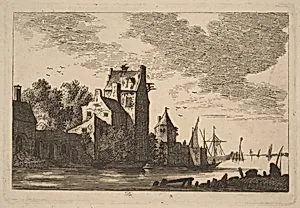
Houses on an Inlet
1726 to 1750
Medium
etching
Classification
Department
CG-E
Museum
National Gallery of Art, Washington, D.C.
Credit
Rosenwald Collection
Accession Number
1980.45.1503
Rights
Public Domain
Art Historical Context
Nestled along a serene inlet, *Houses on an Inlet* is a delicate etching attributed to the Austrian artist Franz Edmund Wetter, crafted sometime between 1726 and1750. Weirotter (1719–1771), a printmaker, specialized in evocative landscapes that captured the quiet beauty of natural and architectural scenes. This work exemplifies his early style, blending precise observation with a sense of atmospheric depth, during an era when etching gained popularity for its ability to reproduce intricate details on paper. Etching, the medium here, involves drawing lines into a wax-coated copper plate, which acid then etches to create tonal variations and fine textures. This technique allowed Weirotter to render the shimmering water, clustered houses, and distant horizons with remarkable subtlety, evoking the Rococo era's delight in picturesque views. As part of the National Gallery of Art's Rosenwald Collection (Department CG-E), it highlights 18th-century European printmaking's role in democratizing art, making scenic vistas accessible beyond oil paintings. Today, this print invites visitors to ponder everyday coastal life in the 1700s, a time of expanding trade and exploration. Its subtle craftsmanship reminds us how Weirotter's vedute-like compositions bridged topography and artistry, preserving fleeting moments of harmony between humanity and nature.