
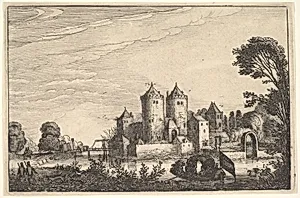
The Castle
ca. 1616
Medium
Etching
Dimensions
plate: 5 1/8 x 7 13/16 in. (13 x 19.8 cm) sheet: 5 1/4 x 7 15/16 in. (13.4 x 20.1 cm)
Classification
Prints
Department
Drawings and Prints
Museum
Metropolitan Museum of Art, New York, NY
Credit
Bequest of Phyllis Massar, 2011
Accession Number
2012.136.575
Rights
Public Domain
Tags
Art Historical Context
Jan van de Velde II created *The Castle* around 1616 as an etching on paper, a medium prized in the Dutch Golden Age for its ability to capture intricate details and tonal effects through acid-etched lines. Measuring just over five by eight inches, this modest print exemplifies the intimate scale often favored by seventeenth-century Dutch artists, allowing collectors to appreciate fine landscape views in private settings. During this period, the newly independent Dutch Republic fostered a flourishing print culture, with artists like van de Velde contributing to a growing interest in naturalistic landscapes. His work reflects the era’s fascination with the countryside, where castles served as symbols of both historical continuity and the peaceful stability following years of conflict. Etchings such as this one were widely circulated, helping to shape a shared visual identity of the Dutch terrain. The Metropolitan Museum’s impression, acquired through the bequest of Phyllis Massar, highlights the enduring appeal of these prints. Van de Velde’s delicate line work invites viewers to linger over the architectural forms and surrounding scenery, offering a quiet window into early modern European life.
About the Artist
Jan van de Velde II · 1593–1641
Jan van de Velde II (1593–1641) was one of the most accomplished Dutch printmakers and draughtsmen of the early seventeenth century, born in Haarlem into a dynasty of celebrated calligraphers and artists. His father, Jan van de Velde I, was a renowned writing master, and his cousin Willem van de Velde the Elder would later become a distinguished marine painter. Jan II studied engraving under Jacob...