
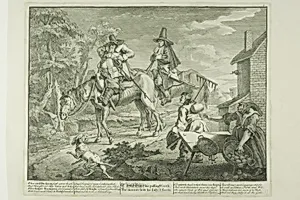
Hudibras Sallying Forth, plate two from Hudibras
February 1725/26
Medium
Etching and engraving in black on cream paper edge mounted on cream wove paper
Dimensions
Image: 24.6 × 33.6 cm (9 11/16 × 13 1/4 in.); Plate: 27 × 34.5 cm (10 11/16 × 13 5/8 in.); Primary support: 27.3 × 34.8 cm (10 3/4 × 13 3/4 in.); Secondary support: 36.5 × 45.9 cm (14 3/8 × 18 1/8 in.)
Classification
engraving
Department
Prints and Drawings
Museum
Art Institute of Chicago
Accession Number
184607
Rights
Public Domain
About this artwork
William Hogarth illustrated the story of a sad-sack adventurer named Hudibras in twelve engravings. His source was Samuel Butler’s satirical, mock-heroic poem written in the vein of Cervantes and Rabelais. Ridiculing the puritan party’s attempts to overthrow the British monarchy during the Great Civil War of 1640, Butler’s poem exposes the hypocrisy and pretensions of the Presbyterians, Independents, and Zealots who hoped to establish themselves as leaders. Hudibras’ grand departure into the wo...
Art Historical Context
William Hogarth's *Hudibras Sallying*, the second plate from his 1726 series illustrating Samuel Butler's epic satirical poem *Hudibras*, captures the bumbling knight Hudibras his squire Ralpho off on a comically misguided adventure. Published in February 1725/26, this etching and engraving reflects Hogarth's mastery of 18th-century British satire, poking fun at Puritan hypocrisy and religious fanaticism decades after the English Civil War. The poem, a bestseller since 1663, mocked the era's zealots through Hudibras's pompous folly, and Hogarth's vivid scenes brought its humor to life for a wide audience via affordable prints. Hogarth's technique shines in the intricate black-line etching and engraving on cream paper, allowing dense, narrative-packed compositions (image: 24.6 × 33.6 cm) filled with exaggerated figures, witty details, and social commentary. As a pioneer of sequential art, he blended caricature with moral allegory, influencing later cartoonists like Rowlandson and Gillray. This plate buzzes with chaotic energy—crowds jeering, animals scattering—highlighting Hogarth's observational genius. Housed in the Art Institute of Chicago's Prints and Drawings department, this work exemplifies how prints democratized art, making sharp cultural critique accessible beyond elite canvases. Visitors today still chuckle at its timeless roast of self-righteous bluster.
About the Artist
William Hogarth · 1697–1764
William Hogarth (1697-1764) was an English painter, printmaker, and pictorial satirist who became the first great English-born artist to attract admiration abroad. Born into poverty in London, the son of a failed schoolmaster who was imprisoned for debt, Hogarth's early experiences with the harsh realities of 18th-century urban life profoundly shaped his artistic vision. After apprenticing with si...