
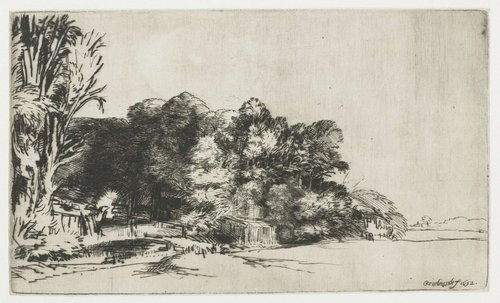
Huis verscholen tussen bomen
Medium
drypoint
Dimensions
210; 124
Rights
Public Domain
About this artwork
droge naald
Art Historical Context
Nestled within Rembrandt van Rijn's masterful printmaking oeuvre, *Huis verscholen tussen* (House Hidden Among Trees), created in 1652, the Dutch master's fascination with the intimate Dutch landscape. This drypoint etching, measuring a modest 124 mm high by 210 mm wide, exemplifies Rembrandt's shift toward atmospheric, evocative scenes during his mature period. Amid the Golden Age of Dutch art, when landscapes celebrated the flat polders and wooded estates of the Netherlands, Rembrandt transformed simple rural motifs into profound studies of light and shadow. The drypoint technique—known in Dutch as *droge naald*—is central to its allure. Rembrandt scratched directly into a copper plate with a sharp needle, raising a soft burr that held ink to produce rich, velvety lines and tonal depths unattainable in traditional etching. This intimate medium allowed for painterly effects, with dense foliage enveloping a hidden house, evoking mystery and seclusion. Unlike his grand history paintings, this print reveals Rembrandt's experimental side, pushing printmaking toward the expressiveness of drawing. As one of Rembrandt's later landscapes, it reflects his financial strains and personal introspection in 1650s Amsterdam, yet radiates quiet beauty. Collectors prize its rarity and technical bravura, offering visitors a window into the genius who redefined both painting and print.
About the Artist
Rembrandt van Rijn · 1606–1669
Rembrandt Harmenszoon van Rijn (1606–1669) stands as one of the greatest visual artists in the history of Western art and the most important Dutch painter of the 17th century. Born in Leiden to a prosperous miller's family, Rembrandt transformed painting through his revolutionary use of light and shadow, his psychological depth in portraiture, and his elevation of etching to a fine art. His approx...