
Human Misery
1898–99
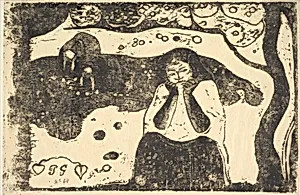
Medium
Woodcut on transparent laid tissue paper
Dimensions
7 5/8 x 11 3/4 in. (19.4 x 29.8 cm): block 9 x 11 7/8 in. (22.9 x 30.2 cm): paper
Classification
Prints
Department
Drawings and Prints
Museum
Metropolitan Museum of Art, New York, NY
Credit
The Elisha Whittelsey Collection, The Elisha Whittelsey Fund, 1952
Accession Number
52.608.1
Rights
Public Domain
Tags
Art Historical Context
Paul Gauguin's *Human Misery*, created between 1898 and 1899, captures the artist's fascination with Tahitian life during his second stay on the island. A poignant woodcut printed on delicate, transparent laid tissue paper (measuring about 7⅝ × 11¾ inches for the block), this work belongs to Gauguin's experimental print series from his time in the South Seas. Fleeing the industrialization of Europe, Gauguin sought a "primitive" paradise in Polynesia, where he depicted local women with raw emotional depth, as suggested by the artwork's evocative title and tagging. As a Post-Impressionist and Symbolist, Gauguin revolutionized printmaking with rough-hewn woodcuts inspired by Japanese ukiyo-e and folk traditions. He carved the blocks himself, often using makeshift tools, resulting in bold, uneven lines and textured surfaces that convey human suffering and exotic allure. The thin tissue paper enhances translucency, allowing light to play through the image and heighten its haunting quality—innovative for late 19th-century prints. Housed in the Metropolitan Museum of Art's Drawings and Prints department, *Human Misery* exemplifies Gauguin's quest to blend Western technique with non-European motifs, influencing modern art's embrace of cultural hybridity and emotional primitivism. A stark reminder of personal and colonial struggles, it invites visitors to ponder the artist's complex legacy.
About the Artist
Paul Gauguin · 1848–1903
Paul Gauguin (1848-1903) was a French Post-Impressionist painter whose bold experiments with color, form, and subject matter made him one of the most influential figures in the transition from 19th-century art to modernism. His rejection of European civilization for the perceived authenticity of 'primitive' cultures established an archetype of artistic exile that continues to resonate. Gauguin's ...