
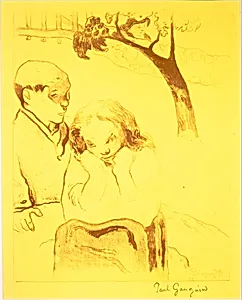
Human Misery, from the Volpini Suite: Dessins lithographiques
1889
Medium
Zincograph printed in brown ink on chrome yellow wove paper; first edition
Dimensions
Image: 11 1/16 × 9 in. (28.1 × 22.9 cm) Sheet: 19 × 13 3/8 in. (48.3 × 33.9 cm)
Classification
Prints
Department
Drawings and Prints
Museum
Metropolitan Museum of Art, New York, NY
Credit
Rogers Fund, 1922
Accession Number
22.82.2(3)
Rights
Public Domain
Tags
Art Historical Context
In 1889, Paul Gauguin, a pioneering Post-Impressionist, *Human Misery* as part of his *Volpini Suite: Dessins lithographiques*, bold series of 11 zincographs exhibited at the Café des Arts in Paris. This alternative venue, run by Arturo Volpini, hosted Gauguin's works during the 1889 Exhibition, positioning them as a provocative counterpoint to the official Impressionist. The print captures themes of contemplation and human suffering, evoking the quiet despair of men and women amid everyday struggles—a recurring motif in Gauguin's early symbolic explorations before his iconic voyages to Tahiti. Printed in warm brown ink on vibrant chrome yellow wove paper, this first-edition zincograph mimics the fluid spontaneity of Gauguin's drawings while leveraging lithography's reproducibility. Zinc plates allowed for rich tonal variations and expressive lines, marking Gauguin's innovative push beyond oil painting into printmaking. At 11 1/16 × 9 inches, its intimate scale draws viewers into the emotional depth of "human misery," blending realism with emerging Symbolist tendencies. Acquired by The Metropolitan Museum of Art via the Rogers Fund in 1922, this work exemplifies Gauguin's brief but influential printmaking phase, bridging Impressionism's light with modernism's psychological intensity. A poignant glimpse into fin-de-siècle anxieties, it invites reflection on universal hardship.
About the Artist
Paul Gauguin · 1848–1903
Paul Gauguin (1848-1903) was a French Post-Impressionist painter whose bold experiments with color, form, and subject matter made him one of the most influential figures in the transition from 19th-century art to modernism. His rejection of European civilization for the perceived authenticity of 'primitive' cultures established an archetype of artistic exile that continues to resonate. Gauguin's ...