
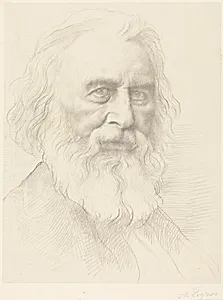
H.W. Longfellow, 2nd plate
1826 to 1850
Medium
transfer lithograph?
Classification
Department
CG-E
Museum
National Gallery of Art, Washington, D.C.
Credit
Gift of George Matthew Adams in memory of his mother, Lydia Havens Adams
Accession Number
1948.6.36
Rights
Public Domain
Art Historical Context
Discover the evocative portrait *H.W. Longfellow, 2nd plate*, a transfer lithograph by French-born artist Alphonse Leg (1837–1911). This print captures the likeness of the renowned American poet Henry Wadsworth Long, whose works like *Evangeline* and *The Song of Hiawatha* enchanted 19th-century audiences. Created sometime between 1826 and1850, it reflects the era's fascination with literary celebrities, blending portraiture with the burgeoning art of printmaking to make famous faces accessible to a wide public. Legros, a master of Realism who later championed etching in Britain, employed the transfer lithograph technique here—a clever method where the image is first drawn on paper and then chemically transferred to a lithographic stone. This allowed for intricate details and tonal subtlety, bridging drawing's spontaneity with lithography's reproducibility. As a "2nd plate," it likely represents a refined state of the print, showcasing Legros' meticulous revisions for greater expressiveness. Now housed in the National Gallery of Art's Department of Prints (CG-E), this work entered the collection as a thoughtful gift from George Matthew Adams in memory of his mother, Lydia Havens Adams. It stands as a testament to the enduring cultural bridge between American literature and European artistic innovation, inviting visitors to ponder Longfellow's thoughtful gaze through Legros' skilled lens.
About the Artist
Alphonse Legros · 1837–1911
Alphonse Legros (1837–1911) was born in Dijon, France, and trained in Paris at the drawing school of Horace Lecoq de Boisbaudran, whose unconventional teaching method — which emphasised memory drawing and acute observation over academic convention — would leave a lasting mark on Legros's practice. At Lecoq's school he formed friendships with Jules Dalou and Auguste Rodin that endured throughout hi...